
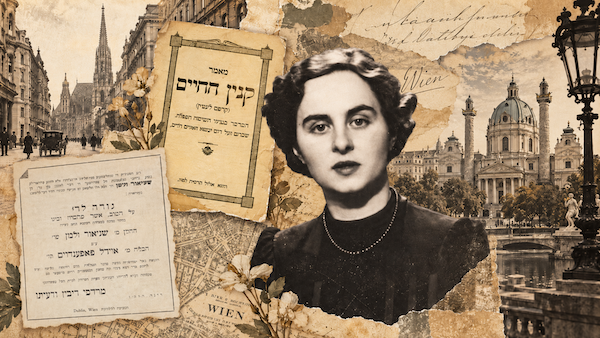
On February 22, 1917, a beautiful baby girl was born in Vienna to Kalonymus Kalman Pappenheim and Sophie Schiff. She was named Eidel and was the second of seven children born to the Pappenheim family. Time would tell how much Eidel would accomplish in her short 26 years of life.
The Pappenheim family were Orthodox Jews and were very devoted to communal affairs. Eidel’s grandparents were among the founders of the Schiffschule, formally known as Kahal Adass Yisroel, which was an important Orthodox synagogue and educational center in Vienna. The shul extended to far more than just a place of worship. It included educational facilities and various communal services that created a close-knit environment where Jewish values were fostered through family, education, and mitzvah observance.
This environment played a major role in shaping Eidel. The Pappenheim family lived in Vienna’s Leopoldstadt district, which was the center of much of the city’s Jewish life. Although Vienna was famous for its culture, intellectual life, music, and cosmopolitan atmosphere, the Jewish community of the interwar period faced growing political and social instability. This was caused in no small part by the collapse of the Austro-Hungarian Empire after World War I, which left Austria economically and politically unsettled. In this environment, socialism flourished and with it there was an upsurge in antisemitism. The challenge for the Jewish community became not only staying afloat politically, but preserving the Jewish way of life in an increasingly secular society.
Eidel’s family responded by doubling down on their commitment to Torah education and communal service. Her grandfather Wolf Pappenheim was involved with Agudath Israel, while her father and other relatives continued this tradition. Their home functioned as a meeting place for Jewish leaders and visiting rabbis. Eidel was privileged to grow up seeing Jewish leadership not as a distant profession but as an obligation carried out in everyday life. This certainly moulded Eidel into a teacher and mentor from a reasonably young age.
While Vienna faced economic hardship, Jewish society itself was divided into different factions. There were traditionalists, Zionists, socialists, secular intellectuals, and assimilated Jews. In response to this, Orthodox leaders instituted new educational frameworks, one of the most important of which was the Beis Yaakov movement. Jewish girls would be provided with a solid Jewish education to steer them away from the modern and secular culture that was seeping into their society. Eidel was therefore raised in an environment in which educating girls was increasingly regarded as essential to the survival of traditional Jewish life.
It was in Beis Yaakov of Krakow that Eidel became friendly with Basya Epstein Bender and encountered other future leaders of Jewish women’s education. Eidel, together with her sister Liane, became involved in youth groups that taught Torah to other young girls. Not content to remain merely a student, Eidel quickly evolved into a teacher and educator. Eidel believed that Jewish women had the power to influence those beyond their immediate circle. She felt passionately that they were responsible for transmitting Jewish values to children, families, and other communities.
While Vienna faced economic hardship, Jewish society itself was divided into different factions. There were traditionalists, Zionists, socialists, secular intellectuals, and assimilated Jews. In response to this, Orthodox leaders instituted new educational frameworks, one of the most important of which was the Beis Yaakov movement. Jewish girls would be provided with a solid Jewish education to steer them away from the modern and secular culture that was seeping into their society.
Eidel married Schneur Zalman Dubin in February 1937. The wedding took place at the Schiffschule in Vienna and attracted extraordinary attention. This was because it united two prominent Orthodox Jewish families: the Pappenheims of Vienna and the Dubins of Latvia. Eidel’s father-in-law, Mordechai Dubin was one of the most prominent Jewish figures in Latvia at that time. He was involved in Agudath Israel and he represented this movement to the Latvian parliament. He was also involved in many acts of charity and kindness in his community.
Following her wedding, Eidel and Zalman lived in Riga where Eidel continued to teach, lecture, and participate in Jewish communal life. It was there that Eidel came to be known as a phenomenal public speaker. Her life’s mission was educating women and girls on a wide variety of subjects such as Torah observance and Jewish identity. Eidel would bring Sarah Imeinu as an example of a vibrant woman teacher who passed the torch of Torah on to hundreds of other women.
Eidel’s teachings created practical change and reform. Following one of her lectures in Liepāja, the community resolved to restore its women’s mikveh which had fallen into disuse. Eidel viewed a shiur as effective if it inspired someone to change something tangible in their lives.
As the clouds of war darkened over Europe, Eidel’s work shifted from Jewish education to a struggle for survival. The Pappenheim and Dubin families became involved in helping Jewish refugees.
Tragically, Eidel was murdered in the Holocaust at the tender young age of 26. Although she is no longer with us, her legacy lives on. Eidel was a passionate teacher with a thirst to educate others. She was a dynamic speaker who could attract large audiences and inspire communities to take practical action. She was a woman who believed that Torah education was not only the jurisdiction of men, but the proud responsibility of women too.
Her life may have been short, but it was full of meaning and purpose. May her memory be a blessing.
Related articles
 Yom Kippur: Dating Lessons from Moshe Rabbeinu and Adolf Hitler
- Does Hashem Expect Us to Be Flawless?
- Yael: A Woman of Courage and Bravery
- Flora Sassoon: India’s Scholar and Businesswoman
- Queen of Sheba: Pursuing Wisdom for Its Own Sake
- Chuldah: A Woman of Vision, Prayer and Prophecy
- Delilah: A Wife Can Either Uplift Her Husband or Cause His Downfall
- Sarah Schenirer: The Woman Who Revolutionized Jewish Girls’ Education
- Korach: Feeling Out of this World!
- The Women of Shavuot: Torah Through the Eyes of Chutzpah Girls










More articles by Daniella Landau
- Is Independence a Torah Value?
- Artificial Or Genuine Intelligence: A Torah Approach to AI
- Elul: A Time to Work on Relationships
- The Shabbat Queen: The Life and Legacy of Henny Machlis
- Yael: A Woman of Courage and Bravery
- Delilah: A Wife Can Either Uplift Her Husband or Cause His Downfall
- When I Stopped Taking Small Things for Granted
- Ruchie Freier: A Trailblazer in Law, Faith, and Community
- The Life and Legacy of Dr Edith Eger z”l
- Why Organ Donation Is So Close to My Heart