
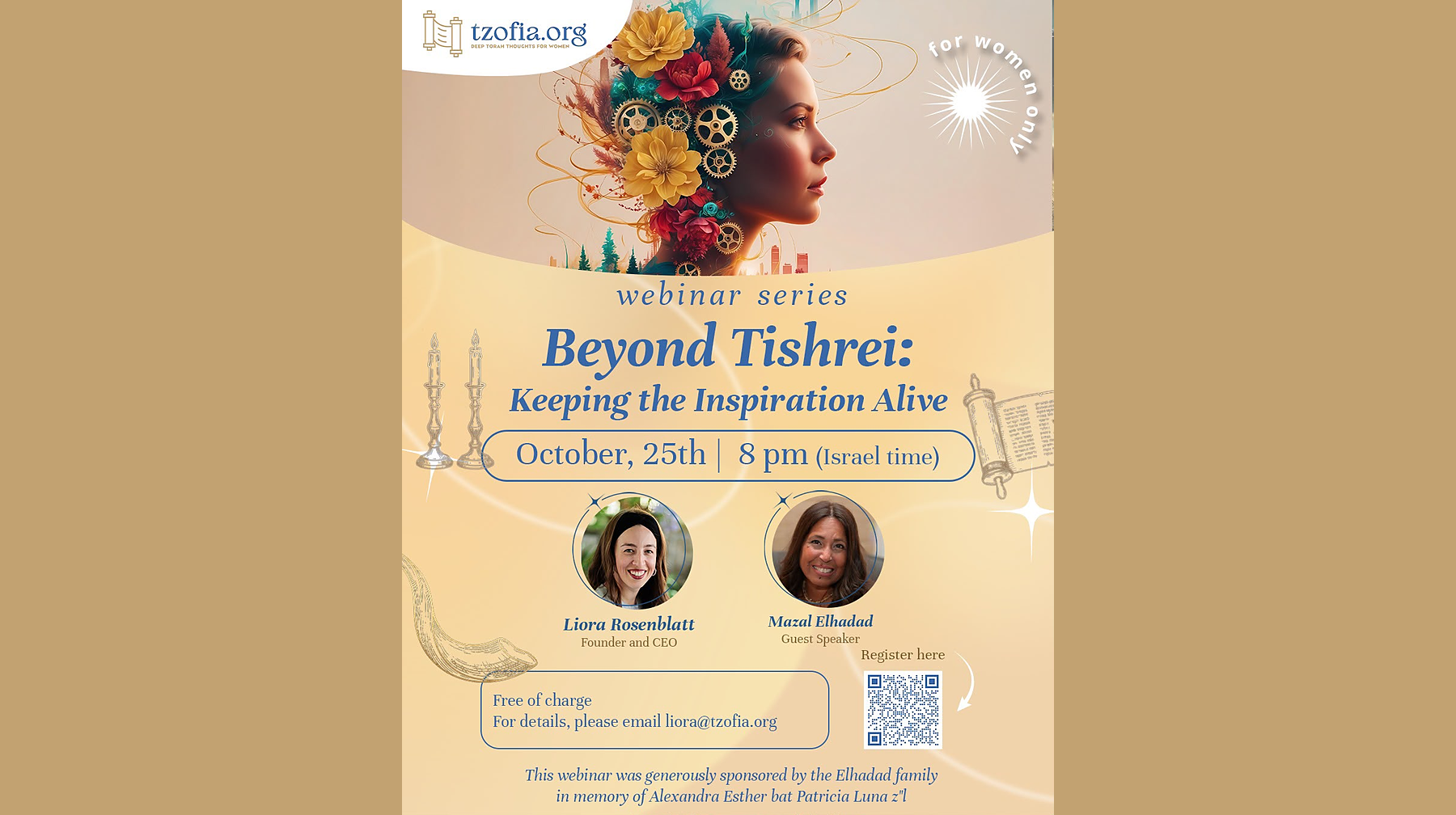
Are you looking for a way to hold onto all the spirituality you experienced over the month of Tishrei?
Read more: Beyond Tishrei: keeping the Inspiration aliveTzofia is excited to invite you to the next webinar in our series:
Beyond Tishrei: Keeping the Inspiration Alive
Featuring Liora Rosenblatt, CEO of Tzofia and Mazal Elhadad, Guest Speaker
Sunday October 25th 8pm (Israel time)
Free | Suggested 20 NIS donationRegister here
-

-
Welcome to our new content category: The Tzofia Podcast, Episode 2…
Read more: Unequal or Different? Exploring Gender Equality in JudaismTzofia is excited to invite you to the next webinar in our series:
Beyond Tishrei: Keeping the Inspiration Alive
Featuring Liora Rosenblatt, CEO of Tzofia and Mazal Elhadad, Guest Speaker
Sunday October 25th 8pm (Israel time)
Free | Suggested 20 NIS donationRegister here
-
Inspiration can be powerful. But how much does it actually change us?..
Read more: Is Inspiration a Torah Concept?Tzofia is excited to invite you to the next webinar in our series:
Beyond Tishrei: Keeping the Inspiration Alive
Featuring Liora Rosenblatt, CEO of Tzofia and Mazal Elhadad, Guest Speaker
Sunday October 25th 8pm (Israel time)
Free | Suggested 20 NIS donationRegister here

-
Beyond Tishrei: keeping the Inspiration alive
Are you looking for a way to hold onto all the spirituality you experienced over the month of Tishrei?
-
Unequal or Different? Exploring Gender Equality in Judaism
Welcome to our new content category: The Tzofia Podcast, Episode 2…
-
Is Inspiration a Torah Concept?
Inspiration can be powerful. But how much does it actually change us?..
Most Popular
 Sarah: Beauty According to the Torah October 25, 2026 One of the first episodes in the Torah regarding Sarah, the wife of Avraham, introduces us to her in a very interesting way. Avraham is forced by a famine to leave his home and travel to Egypt. Concerned that the Egyptians, taken by her beauty, will want Sarah for their own, Avraham takes serious precautions to protect her, for he says, “I know what a beautiful woman you are.” (Bereishit 10:11) And in fact, Avraham’s… Read more
 Hagar: The Consequences of False Judgements October 25, 2026 “Now Sarai, Abram’s wife, had not borne to him, and she had an Egyptian handmaid named Hagar.1” Rashi explains that Hagar is Pharaoh’s daughter, that he sent her with Avraham after the whole wife/sister fiasco because he saw the miracles that happened to Avraham and Sarai and said: “It is better that my daughter be a handmaid in this household, than a mistress in another household.”2 But even if Pharaoh said she should be a… Read more
 Vayeira: Our Salvation Is Born from the Impossible October 25, 2026 Sara, the wife of Avraham, is known to us as ‘Sara Imeinu,’ Sara, our mother. Sara’s primary identity is not only as the mother of Yitzchak, but the mother of the whole Jewish nation. Interestingly, Sara only became a mother at the age of 90 and she passed away at 127. For most of her life, Sara was not a mother. Yet, we know that Sara lived each day of her life to the fullest… Read more