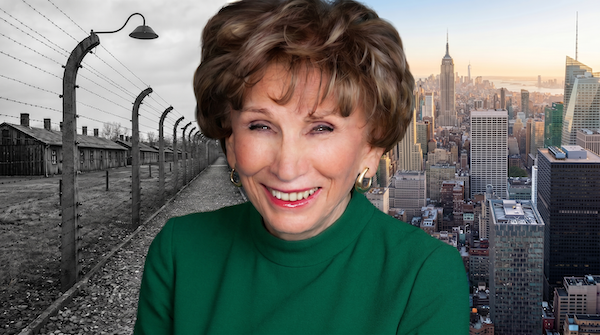
Edith Eger, a Czechoslovakian-born Holocaust survivor, passed away on Tuesday, 27 April 2026. She was 98 years old. Despite the pain and trauma she endured in Auschwitz, she refused to succumb to hopelessness or despair, becoming a shining example of faith born of hardship.
Before the dark clouds of war appeared on the horizon, Edith was a talented ballet dancer and gymnast. She hoped to compete in the Olympics one day; however, her dreams were cut short with the Nazis’ rise to power when she was only 16 years old. On her first night in the camps, Mengele ordered Edith to dance for him. She closed her eyes and retreated to an inner world where she was no longer cold and hungry nor imprisoned in a death camp. Instead, she was on stage in the Budapest opera house.
From this pivotal experience, Eger learned that Auschwitz wasn’t the worst prison. The harshest jail is the prison of the mind. Many of us are trapped by our minds with negative, limiting thoughts that impede our progress and obscure our joy. We have to learn how to unlock our mental prisons so that our souls can soar free. The Baal Shem Tov taught us a similar idea. He said that a man is where his mind is. If your thoughts are sublime and pure, then you will be uplifted and sanctified.
Edith’s life story is not only a testament to survival under unimaginable circumstances, but also a deeply insightful exploration of how suffering can be transformed into strength. When Edith and her sister were liberated in May 1945, most of her friends and family were dead. Her back was broken from constant physical abuse, she was starving, and her body was covered in painful sores. She could barely move from the pile of corpses that she lay amongst. Yet she realized that she had one choice. The choice of how to respond to her suffering. And choose she did. She decided to choose hope. As she once said, “The only thing we can control is our attitude.”
Our holy Torah teaches us that man differs from animals in his power of choice. Animals respond with instinct; man is expected to make a balanced decision. Our holy Torah tells us, “See I have placed before you blessing and curse.”1 The decision is ours as to what to choose.
Elsewhere in the Torah, Hashem gives the Jewish People an impassioned plea, “וּבָחַרְתָּ בַּחַיִּים – Choose life!”2 How do we do this? We employ a dual response. One is heeding the Torah’s words and fulfilling the mitzvot. This fills our souls with Hashem’s sublime light. The other is desisting from evil and avoiding aveirot, which prevents Hashem’s illumination from reaching our holy neshamot.
Our holy Torah teaches us that man differs from animals in his power of choice. Animals respond with instinct; man is expected to make a balanced decision. Our holy Torah tells us, “See I have placed before you blessing and curse.” The decision is ours as to what to choose.
Liberation, however, did not immediately bring Edith peace. Like many survivors, she carried deep psychological scars, including guilt, grief, and unresolved trauma. For years, she struggled with nightmares and emotional pain, often suppressing her experiences in an effort to move forward.
After the war, Edith emigrated to the United States, where she married and built a family. She earned a doctorate in clinical psychology and became a licensed therapist, specializing in trauma, post-traumatic stress, and resilience. She chose to draw on her own experiences to help others dealing with pain and difficulty.
Edith earned her doctorate in her forties. This underscores a fundamental belief that she had: It is never too late to grow, heal, and redefine oneself. While Edith acknowledged that trauma is real and leaves its mark, it is up to each individual how to deal with that pain. One has to choose to be a victim or a survivor. Her message is both simple and profound: “You can’t change what happened, but you can choose how you relate to it.”
Eger wrote two books, The Choice and The Gift. In The Choice, which she wrote at age 90, Eger recounts not only her time in the camps but also her long journey toward healing. Her second book, The Gift, offers practical tools for dealing with common psychological challenges such as fear, anger, and self-doubt.
Eger’s legacy is multifaceted. She is a survivor, a scholar, a therapist, and a teacher. She is a role model and a mentor.
She may not have grown up with the love of her parents, as their lives were brutally cut short, but she did merit seeing four generations rise from the ashes.
May we merit to carry her message in our hearts and have the clarity and purpose to choose life!
Related articles
 Is Independence a Torah Value?
- What Does It Mean to Be Rich?
- What Is Dat Moshe?
- Beyond Yom Kippur: Making Change Last
- Lilith: A Demon, Not to Be Defended nor Glorified
- Defining the Tzaddik, Beinoni and Rasha
- Aseret Yamei Teshuva and Short-Term Kabbalot: Whom Are We Fooling?
- A New Reading of the Book of Life
- Blowing the Shofar: Confusing the Satan?
- What Makes a Good Year? The Secret to a Successful Rosh Hashanah









More articles by Daniella Landau
- Is Independence a Torah Value?
- Eidel Pappenheim-Dubin: A Forgotten Pioneer of Jewish Women’s Leadership
- Artificial Or Genuine Intelligence: A Torah Approach to AI
- Elul: A Time to Work on Relationships
- The Shabbat Queen: The Life and Legacy of Henny Machlis
- Yael: A Woman of Courage and Bravery
- Delilah: A Wife Can Either Uplift Her Husband or Cause His Downfall
- When I Stopped Taking Small Things for Granted
- Ruchie Freier: A Trailblazer in Law, Faith, and Community
- Why Organ Donation Is So Close to My Heart