It was a regular, sunny Sunday in March. My mom, dad, sister, and brother were all lounging around the pool, enjoying the warm weather. Suddenly, my dad started making grunting noises, grabbed hold of his chest, and collapsed. My mom looked at his prone figure in horror and quickly called 911.
The paramedics raced to the scene and grimly announced that my dad had experienced a massive heart attack. They began resuscitation efforts, to no avail. They tried desperately to save him, again and again. They felt they couldn’t declare the death of a thirty-nine-year-old so quickly. Finally, they got a pulse back! They raced him off to the hospital, sirens blaring, lights flashing, and settled him into the ICU unit.
Thus began an intensive recovery process. The cardiologist looked my mom in the eye and told her that eighty percent of my dad’s cardiac muscle had been destroyed. He also told her that the younger the patient suffering from a heart attack, the less chance he has of having a full recovery. He then mentioned that if my dad did recover, the process of rehab would be a gruelling one.
My mom blinked back tears, squared her shoulders, and bravely told the doctor that she would do all she could to help my dad heal.
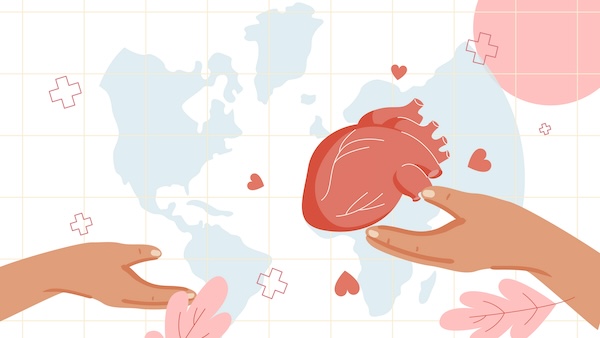
Judaism holds the preservation of human life as one of its highest ideals—a value that profoundly shapes its approach to organ donation. While different branches of Judaism engage in thoughtful discussion on the topic, a broad consensus has emerged: organ donation is not only permitted, but in many cases may be a moral responsibility.
At the heart of this perspective is the principle of pikuach nefesh—the obligation to save a life. The Rabbis teach that one who saves a single life is regarded as if he saved an entire world, highlighting the immeasurable worth of every individual soul.
The doctors didn’t give my father too much hope. But G-d decided otherwise. Against the odds, my dad fought for his survival and won. He was blessed to have another five children after his recovery and felt truly privileged to have a new lease on life.
He was well for another thirty years. He opened up his own business, started Hatzolah in South Africa, and established a new primary school. But after his sixty-eighth birthday, he began to feel lethargic and out of breath. A visit to his cardiologist confirmed our worst fears. His heart was failing; it was a mere lump of flaccid muscle, and the only option was a heart transplant. Soon. The problem? South Africa has a very low organ donation rate. Only 0,2% of the population is registered as organ donors. This amounts to fewer than one or two donors per million people! A bitter irony is that the country that performed the first successful heart transplant has one of the lowest organ donation rates in the world. Go figure.
With G-d’s grace, he was able to get an organ within six weeks. The doctors performed the life-saving surgery in an operation that took 8 hours. The recovery and rehab were no simple matter, but three months down the line, we had my dad back! He felt like a new man with a new heart!
Having seen the gains and benefits of organ donation, I wouldn’t hesitate to register as a kidney donor. It heals the sick, saves lives, and buys patients a tomorrow.
Many people are afraid to consider organ donation. They think twice and even three times before being tested as a possible match for a hopeful recipient. Most of their fear and apprehension is a result of ignorance about what the process entails. Let’s explore what Judaism has to say about this critical topic.
Judaism holds the preservation of human life as one of its highest ideals—a value that profoundly shapes its approach to organ donation. While different branches of Judaism engage in thoughtful discussion on the topic, a broad consensus has emerged: organ donation is not only permitted, but in many cases may be a moral responsibility.
At the heart of this perspective is the principle of pikuach nefesh—the obligation to save a life. The Rabbis teach that one who saves a single life is regarded as if he saved an entire world1, highlighting the immeasurable worth of every individual soul. The Gemara goes even further, emphasizing that each person should view the world as having been created just for him2, underscoring the infinite value of human life.
At the same time, Jewish law places great importance on kavod ha-met, the dignity of the deceased. The body is to be treated with deep respect, with practices such as prompt burial and the avoidance of unnecessary disturbance. On the surface, organ donation may appear to challenge this principle, as it involves medical procedures after death. However, most rabbinic authorities rule that when saving a life is at stake, pikuach nefesh takes precedence. In this light, honoring life becomes the highest form of respect.
There is also a prohibition against deriving benefit from a deceased body, which could raise concerns about transplantation. Yet here too, the saving of life overrides the restriction. Organ donation is not viewed as a misuse of the body, but as a profound act of compassion—one that embodies Judaism’s deepest commitment to preserving and valuing life
Lori Palatnick, a religious woman living in America, donated one of her kidneys to a Jewish woman with many young children. When asked why she did this, she simply replied, “G-d gave us two kidneys. One is to keep, and the other is to give away to someone in need.”
Related articles
 Is Independence a Torah Value?
- My Experience with Special Needs Individuals
- Pregnancy and Fasting on Yom Kippur
- A New Reading of the Book of Life
- The Interconnection between Rosh Hashana and Yom Kippur
- What Makes a Good Year? The Secret to a Successful Rosh Hashanah
- Elul: A Time to Work on Relationships
- Rosh Hashanah: The Deeper Meaning of the Shofar
- “Circle, Arrow, Spiral”: The Dynamics of Change and Acceptance in Teshuva
- Is Self-Care Aligned with Torah Values?






More articles by Daniella Landau
- Eidel Pappenheim-Dubin: A Forgotten Pioneer of Jewish Women’s Leadership
- Is Independence a Torah Value?
- Artificial Or Genuine Intelligence: A Torah Approach to AI
- Elul: A Time to Work on Relationships
- The Shabbat Queen: The Life and Legacy of Henny Machlis
- Yael: A Woman of Courage and Bravery
- Delilah: A Wife Can Either Uplift Her Husband or Cause His Downfall
- When I Stopped Taking Small Things for Granted
- Ruchie Freier: A Trailblazer in Law, Faith, and Community
- The Life and Legacy of Dr Edith Eger z”l