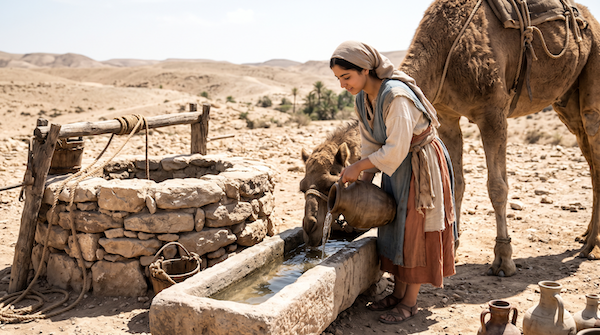
We first meet Rachel Imeinu, one of our holy imahot, when she comes down to the well as a shepherdess, herding her father’s sheep. It is there that she encounters Yaakov, who had come down to Charan in search of a wife. When Yaakov gazed at Rachel, he was instantly attracted to her, so he ordered the other shepherds to go about their business pasturing the sheep so that he would have time alone with her.1 Yaakov’s attraction to Rachel was purely spiritual in nature, as he foresaw with ruach hakodesh that they shared a common destiny.
The Torah describes Rachel’s great beauty with the words וְרָחֵל הָיְתָה יְפַת תֹּאַר וִיפַת מַרְאֶה “Rachel was beautiful of form and beautiful of appearance.” The Ibn Ezra comments that each of Rachel’s facial features was striking: Her eyes, nose, and lips were all of beautiful form. This contrasts sharply with Leah’s looks. וְעֵינֵי לֵאָה רַכּוֹת “Leah’s eyes were tender.” The Gemara sheds light on Leah’s misery. It was common knowledge that Rivka had given birth to two sons, and Lavan, Rivka’s brother, had borne two daughters. It was assumed that Rivka’s older son, Eisav, would be given in marriage to Lavan’s older daughter, Leah, and the younger son, the tzaddik Yaakov, would wed the younger daughter, Rachel. When Leah heard about Eisav’s reputation as an idol-worshiper, murderer, and hunter, she grew terrified at the notion of becoming his future wife. She cried and begged Hashem in heartfelt tefilla, “Please, Hashem, do not let me fall to the lot of the rosha, Eisav.” So sincere was her crying that her eyelashes fell out of her eyes.
Yaakov’s love for Rachel was so deep that the seven years he toiled for her hand in marriage flew by. This was because his love for her was holy and elevated. Her physical beauty was a reflection of inner harmony and internal perfection.
One of the first things we are told about our matriarch Rachel was that she was a shepherdess. The nature of this job demonstrates that she had a kind, compassionate, and caring nature.
Avraham epitomized chessed, and Yitzchak represented gevura. Yaakov was the synthesis of both and exemplified emes. Yaakov saw that Rachel would complement him in his life’s mission and bring truth and harmony into the world.
Rachel demonstrated vatranus in the most meaningful way possible when she gave over the simanim to Leah, thereby allowing her to marry the husband she longed to spend her life with. The Kedushas Levi comments that when Rachel told the simanim to Leah, she didn’t know that Yaakov would marry her too. Her destiny could have been radically different, and she could have been given as a wife to Eisav. When Yaakov realized how selflessly she had acted towards Leah, his love for her grew exponentially.
While Leah gave birth to one son after another, Rachel remained barren. The Torah describes Rachel’s feelings with the words, “וַתְּקַנֵּא רָחֵל בַּאֲחֹתָהּ – And Rachel was jealous of her sister.“ A tzaddeket of Rachel’s calibre was not envious of Leah’s good fortune; rather, she was jealous of her sister’s righteousness. She reasoned that Leah must be more righteous than she was, that she merited bearing sons to Yaakov.
Rachel demonstrated vatranus in the most meaningful way possible when she gave over the simanim to Leah, thereby allowing her to marry the husband she longed to spend her life with. The Kedushas Levi comments that when Rachel told the simanim to Leah, she didn’t know that Yaakov would marry her too. Her destiny could have been radically different, and she could have been given as a wife to Eisav. When Yaakov realized how selflessly she had acted towards Leah, his love for her grew exponentially.
We see further examples of Rachel’s selflessness when she gives her maidservant Bilha to Yaakov to marry since she hadn’t borne any children to Yaakov. The Seforno says that when Hashem saw her desperation through this act, He remembered Rachel and allowed her to fall pregnant.
Rachel named her long-awaited son Yosef, for she said, אָסַף אֱלֹהִים אֶת חֶרְפָּתִי – “Hashem has gathered in my shame.” Her beloved son reversed the humiliation of many years of childlessness.
Yaakov Avinu married two wives who had two totally different functions to fulfill. Rav Dessler explains that Yaakov needed to be married to both Rachel and Leah because each one aided him in fulfilling a different role in his life. Rachel was Yaakov’s intended wife for Olam Hazeh. Her mission was to elevate the material world and, in doing so, create a kiddush Hashem. Leah was the wife of Yisrael, the name Yaakov achieved after battling with Eisav’s angel. She represented the struggle to go beyond physicality and scale spiritual heights.
Rachel’s life was short, as she died in childbirth with Binyamin, but even after death, she continues to advocate for her children. People swarm to Kever Rochel to daven and ask Hashem for salvation in the merit of our righteous matriarch. Just as Hashem answered the grief-stricken Jews being led to exile in Bavel in the merit of Rachel, may He answer any Jew in pain in the zechut of Mama Rachel. May her memory be a blessing.
- Chizkuni ↩︎
Related articles
 Beyond Tishrei: keeping the Inspiration alive
- Is Inspiration a Torah Concept?
- Lech Lecha: The Significance of a Name Change
- What Is the Nature of Simchat Torah’s Joy?
- A Feminine Perspective on the Shofar
- Ha’azinu: Tapping into the Holy Dew
- A Closer Look at Eishet Chayil
- Lala Soulika: Dying for the Sake of Tzniut
- Jewish Mourning: Feeling the Pain While Continuing Life
- The Missing Conversation in Women’s Torah Media is Tzofia.org









More articles by Daniella Landau
- The Incredible Power of One Small Word: Amen!
- When I Stopped Taking Small Things for Granted
- Is Independence a Torah Value?
- Eidel Pappenheim-Dubin: A Forgotten Pioneer of Jewish Women’s Leadership
- Artificial Or Genuine Intelligence: A Torah Approach to AI
- Elul: A Time to Work on Relationships
- The Shabbat Queen: The Life and Legacy of Henny Machlis
- Yael: A Woman of Courage and Bravery
- Delilah: A Wife Can Either Uplift Her Husband or Cause His Downfall
- Ruchie Freier: A Trailblazer in Law, Faith, and Community