
I was blessed to grow up with three older brothers, my oldest having a rare genetic bone disease called McCune Albright Syndrome. In short, the disease limited Shane’s physical abilities (due to frequent bone fractures and tissues being torn), issues with his internal organs, facial abnormalities, and a plethora of health issues in addition to the disease itself. Although he was able to walk for a few years of his life, without pain and constant hospital visits, he eventually lived to 33 years old in a wheelchair after a severe accident. Over the years, I spent not only a lot of time with a special needs brother, but with Shane’s friends and community, made up of both physically and mentally disabled individuals. In school, however, I noticed people with special needs were left out. They were sent to their own classrooms, often sat with their helpers (away from other students) at lunch, and even when “included” in certain activities, were not warmly welcomed or even acknowledged by the majority. Perhaps their differences made others uncomfortable. Perhaps, because of the exposure in my own home, I knew they were no different than me – they needed connection, friendship, and acknowledgment like any other young person. Lastly, I knew that these kids had much more on the inside than people were willing to consider due to their outward differences.
I witnessed a true testament to the topic of this article – that special needs individuals are regarded highly amongst Jews – at an Aish conference I attended in college. In a room filled with what I would have called then “very religious looking men”, there was one young man with Down syndrome. Seeing this young man with Down syndrome, I feared that he too would be ignored…avoided…cast away… Low and behold, in what was a glorious shock to my system, music started to play. The room of (many) religious men promptly stood up, moved the tables out of the way, and started dancing. Of course, the special young man joined in! Without skipping a beat, the men grabbed hands with one another, and created a dancing circle. There was one individual in the middle, face beaming with joy and pride – it was the young man. He was being celebrated, uplifted, and what stood out to me the most – he was not ignored, but honored.
A year or so later, I heard a remarkable story that brought me back to this glorious day at the Aish conference. A rabbi, whom I cannot remember, was speaking about Judaism teaching us “there is much more than what meets the eye”. Someone might look a certain way, or appear to be a certain way (especially those with special needs), and we assume the worst. The story told by this rabbi challenged this habitual way of thinking. He shared a story of an esteemed, revered, and beloved rabbi who gathered a group of men for an event of some kind. As he sat at the head of the table, the room remained silent, as each set of eyes stayed fixed on the holy man. After some time, a man entered the room with his young son – who was disabled. The esteemed rav quickly sprung to his feet, and in suit, his guests rose in curiosity. They looked to the man who’d entered the room with awe. They thought to themselves, ‘If the Rav is standing for such a man – he must be great! He must be a gadol! He must be worthy of tremendous honor!’ The guests, however, soon noticed that the rabbi had his eyes not on the man, but on the disabled young boy. One of the guests spoke up, his curiosity getting the best of him. “Honorable Rav, to whom are we giving the honor?” Keeping his tear-filled eyes steadily on the boy, the rabbi responded, “For the Rav.” The story is explained as follows: there are special neshamas, or souls, in this world, and sometimes (even often) they come in the form of a physically or mentally disabled individual. They already fulfilled their tikkun, or purpose in a previous life – and often, were of tremendous ability, intelligence, Torah knowledge, and sometimes, were a gadol in their past life. When they come back to this world, in a way that many perceive as “less-than”, it is because they have already far exceeded us – and are now here to bring something else – perhaps even more precious – to this world.
Beyond one of the first commandments in the Torah being to reproduce (be fruitful and multiply), we see throughout the ages that Jews value life far beyond birth. There are intricate laws having to do with an endangered fetus (or pregnant mother), questions asked to rabbis about healthcare, life support, and life-saving medications/treatments, and far more beyond the scope of this article. Men and women hold the value of life so dearly that they have children despite all odds, in order to continue the Jewish people and “teach them [the words of Torah] to your children…”
Individuals with special needs teach us so much. They teach us to be more compassionate and curious of others’ differences, rather than afraid and uncomfortable. Rabbi Avigdor Miller tells us that physically disabled individuals teach us to be grateful for our healthy bodies and abilities, as we watch them roll past us in wheelchairs or live despite other seemingly debilitating physical disabilities. They teach us to look deeper than what meets the eye, and understand that we are not like the Romans and Greeks who took the world for face-value – we Jews know there is something much greater going on than what the physical world reveals. In the many differences that Jews have between other peoples and cultures, I have chosen to highlight the value of life, specifically in regard to those who live amongst us with special needs. It is not how much money a person can accumulate, or how many properties one owns. Neither is it how articulate, successful, or popular a person becomes. Education, knowledge, and reputation are respected values, but not a standard we hold others to in order to give them respect.
Let’s talk about Rome, for a moment. A place where, to this day, people visit for the beautiful architecture and to walk the historical stones which paved the way of “thought”, in the form of literature, theater, and of course, philosophy. Seneca, the famous Roman philosopher and writer exemplified the noblest ideas of Roman culture when it came to “valuing human life” in the following statement: “Children, if weak and deformed, we drown, not through anger, but through the wisdom of preferring the sound to the useless.” Beyond killing those deemed unworthy to live in or benefit society, the Romans engaged in the practice of mutilating unwanted children to make them at least “useful” for begging. Horrifically, this practice is still seen today in India.
Beyond one of the first commandments in the Torah being to reproduce (be fruitful and multiply), we see throughout the ages that Jews value life far beyond birth. There are intricate laws having to do with an endangered fetus (or pregnant mother), questions asked to rabbis about healthcare, life support, and life-saving medications/treatments, and far more beyond the scope of this article. Men and women hold the value of life so dearly that they have children despite all odds, in order to continue the Jewish people and “teach them [the words of Torah] to your children…”. Many Jewish homes have a special needs child in the mix, who is beloved, cherished, and educated like all the others. Something I always admired about my own mother was that even after having one special needs child, she went on to have three more children. Shane used to tell her, “My siblings are the greatest gift you gave me.”
In conclusion, what does the Torah teach us about the intrinsic value of human beings? That each one of us is created B’tzelem Elokim, or in the likeness of G-d. Many have translated “likeness” as “image”, causing many to believe that there is something about the human “look” that resembles G-d. The truth, however, is that our likeness to G-d is our internal qualities – our ability to be merciful, kind, and giving; and, the power G-d has given each one of us to create, to grow, and to build, in whatever capacity we are able. When we understand that every single person is of tantamount value – especially in a world where people are now “picking and choosing” who should be granted life or not, both in breath and in opportunities – we must remember that it is our duty as Jews to treat everyone for what they are: a vessel of holiness and G-d’s light on this earth.
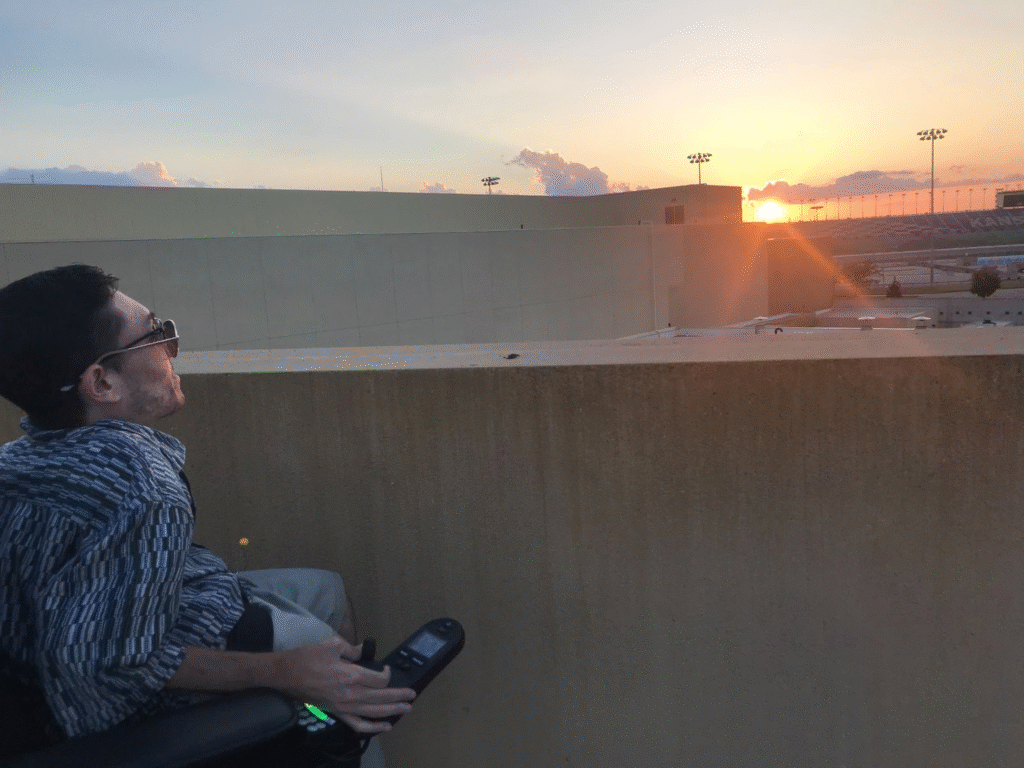
Shane, Esther’s brother
Related articles
 Why Is Rosh Chodesh Attributed to Women?
- Eidel Pappenheim-Dubin: A Forgotten Pioneer of Jewish Women’s Leadership
- Is Independence a Torah Value?
- What Is the Nature of Simchat Torah’s Joy?
- Understanding the Concept of Serving Hashem with Joy
- Artificial Or Genuine Intelligence: A Torah Approach to AI
- Sukkot: Dating Lessons in Vulnerability and Unity
- Defining the Tzaddik, Beinoni and Rasha
- How Not to Get Plagued by Guilt When It Comes to Teshuva
- Pregnancy and Fasting on Yom Kippur



More articles by Esther Lewin
- Lilith: A Demon, Not to Be Defended nor Glorified
- 3 Ways to Co-Create Your New Year
- Rebbetzin Bruria Hutner David: What’s In A Name?
- Judaism, the Omer and the Absense of Music
- How to Reach Your Personal Exodus
- Chametz: Emancipate Yourself from…Yourself
- Freyda, Daughter of the Alter Rebbe: The Balancing Act of Salt
- From Kansas to Tzfat: The Teshuva Story of a Musical Performer
- Abba’s Wife: Pray for Rain, or for Repentance?
- Rebbetzin Denah Weinberg: Surpassing Achievement








One response to “My Experience with Special Needs Individuals”
I read your story with interest but have not had the experience you had. I have a special needs son and in both my San Francisco Bay area community and the State where we now live have faced a lot of marginalization and discrimination due to his disability — particularly in both Jewish communities. Jewish parents have been very unwelcoming and as a young child my son was never invited to birthday parties for their children. At every synagogue we attended (three total) the rabbis were also cold and dismissive. Perhaps you should go around to several Jewish communities and spread your message. The irony is that my special needs son ended up graduating from the University of California, Berkeley with a double major and phi beta kappa and went on to obtain two Masters’ Degrees and publish a book (NOT self-publish by the way) on American history. We have found a home in the disability community but NOT in any Jewish community in this country.