

I have special memories of davening in Kever Machpela, the holy burial site of our Avot and Imahot during my seminary year. I remember beginning my shemonei esrei and the words “elokei Avraham, elokei Yitzchak v’elokei Yaakov” had never felt more real to me. As we read in the parsha about Sarah’s passing and Avraham’s subsequent purchase of Kever Machpela as her burial site, let us explore the depth of this mystical plot of land which pulls Jews from all over to its spiritual caves.
The Midrash Tanchuma writes that the entire poem of Eishet Chayil, as recorded in Mishlei is Avraham’s symbolic eulogy to his wife Sarah. Through its verses, he memorialises her as the ideal Jewish woman. One such pasuk is ‘She envisions a field and takes it,’1 which the Midrash interprets as a reference to her burial plot in Machpela. We may wonder why this pasuk is included as a praise of Sarah, and more practically, how we can describe Sarah purchasing her own burial plot when Avraham acquired it for her. To understand this Midrash, we have to deepen our view of what kever machpela truly was. The Zohar writes that Machpela is the entrance of Gan Eden, each soul which passes on from this world first leaves through Machpela. The Hebrew root of Machpela is kaful which means doubled, twofold. Far from purchasing a random plot of land, Avraham chose Sarah’s burial plot carefully. Machpela is the land of the twofold, it bridges two worlds together; the physical and the spiritual.
Machpela is the central point where the realms of Heaven and earth can intertwine. We see this in the name of the city it is located in, Chevron; derived from the root chibur, connection point. Sarah is buried at the deepest intersection of the material and the holy. It is most accurate to say therefore, that she chose her own plot. Her very essence dictated it. Chayei Sarah, her death reflected her life. In her lifetime, Sarah was a woman who mastered ownership over both the mundane and the lofty2. She was involved in the physical world; cooking, baking and hosting, together with many other of the domestic duties which we perform today. Yet she was also so spiritual that her Shabbat candles never dimmed, her dough never ran out and the cloud of Hashem remained above her tent. Therefore, the highest praise is as in the pasuk, she herself took the land, she belonged at Machpela.Interestingly, Rabbi Reich points out that the halachot of kiddushin, Jewish marriage, are derived from Avraham’s purchase of Sarah’s burial plot3. When a man betroths a woman, we say in Hebrew that he ‘takes’ her. One of the ways this is done is through handing her an item of value (the wedding ring) which she accepts. When Avraham buys the land of Machpela from Ephron, he puts forward 400 silver shekel and declares ‘take it from me.’4 The same ‘taking’ which bound Avraham to the land is the ‘taking’ which halachically binds man and woman in Jewish marriage5. We may wonder why the Torah would want us to learn the halachic basis of a Jewish marriage from a burial plot. Rabbi Reich6 explains that an ideal marriage seeks to recapture the original and seamless unity as was in Gan Eden between man and his wife, Adam and Chava. Initially, the pair was created as one being and marriage is a lofty yet earthly process where a couple learn to bridge the divide between themselves and transcend their needs and desires for the other. When both spouses truly fulfil the other in this way, their souls combine once more and they are restored to that perfect single neshama as was in Gan Eden.
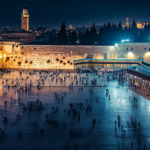
Machpela is a place which speaks to the heart of every Jew today, not because it lies in the holiest city of Yerushalayim, but rather, because it doesn’t. Rav Moshe Wolfson in his Sefer, Emuna Itecha parallels the two cities of Yerushalayim and Chevron (where Machpela is located). Although Yerushalayim is the holy core of Eretz Yisrael, the direction we face when pray and the theme of many of our tefillot and national dreams, it is through Chevron which we are told, each tefilla passes through on its way to Shamayim.
This is the link between Avraham and Sarah’s marriage and Avraham’s burial of Sarah. Their union was so perfect and they complemented each other so seamlessly through their years of marriage, that this burial plot is a symbol that they reached the ultimate goal of Jewish marriage: eternal unity with each other and therefore Hashem. The Zohar writes that the marriage of Avraham and Sarah was like the marriage between body and soul with Avraham representing the soul, and Sarah, the body. Each one with their own mission elevated and gave expression to the other. The Maharal comments on the verse in Yeshaya7 ‘Look to Avraham your father and to Sarah who bore you for when he was one, I called him.’ Although the pasuk refers to both Avraham and Sarah, Hashem calls them ‘one’ because their absolute love and unity rendered them like a single soul. This perfect bond in marriage is eternally echoed through the depths of the cave of Machpela where husband and wife remain fused forever.
Machpela is a place which speaks to the heart of every Jew today, not because it lies in the holiest city of Yerushalayim, but rather, because it doesn’t. Rav Moshe Wolfson in his Sefer, Emuna Itecha8 parallels the two cities of Yerushalayim and Chevron (where Machpela is located). Although Yerushalayim is the holy core of Eretz Yisrael, the direction we face when pray and the theme of many of our tefillot and national dreams, it is through Chevron which we are told, each tefilla passes through on its way to Shamayim. The Zohar tells us that one derivation of the word Machpela is the root meaning ‘to fold’ because the whole of Yerushalayim is folded underneath it. Somehow, these two spiritually glowing cities are linked.
Rav Wolfson contrasts Yerushalayim – which hosted the glorious Beit Hamikdash – with the seemingly simple cave of Machpela, whose only treasures are buried deep underground. He explains that while Yerushalayim is a more spiritually revealed place, that came with the risk of attracting the nations and losing it all. Whereas Machpela has a more elusive spiritual quality. Chevron’s hiddenness and subtle holiness means we will never lose it. Unlike the Beit Hamikdash and its accompanying powerful avoda, song and korbanot which were destroyed, Rav Wolfson explains that Machpela in the special city of Chevron represents the elements of Judaism which are not dependent on place. Even though we cannot enter the Beit Hamikdash in galut and stand in the ‘Awesome Place’ where Yaakov Avinu so tangibly felt Hashem, we can daven at Machpela and remind ourselves of our eternal ‘chibur,’ our unbreakable link to the Avot, and to Hashem.
This helps us understand the Gemara9 which records how Kalev went to pray at Kever Machpela to spiritually strengthen himself when he was sent to spy out the land. Indeed, it was this tefilla which acted as a stronghold for him, who, together with Yehoshua, did not speak badly about the land of Israel. At the time of Kalev’s tefilla, the meraglim are about to commit one of the most devastating sins of our history, one which becomes the anniversary of Tisha B’av, a day of tears, grief and mourning. Kalev turns not to the holiest city of Yerushalayim, because Klal Yisrael are about to lose their Mikdash. Rather, he turns to Chevron, the mysterious city of hidden holiness, a city which Klal Yisrael can never lose. At the site of Machpela, we remind ourselves and Hashem that our closeness has never and will never change.
We daven for the rebuilding of the spiritual epicentre of our land, Yerushalayim, yet what may hold us through a long and hard galut is the site of Machpela which whispers holiness from the innermost recesses of its deep caves. We dream to stand in the joyous streets of Yerushalayim once more, but while we wait we hold onto this underground network of connection, untainted by galut.
- Mishlei 31:16 ↩︎
- As explained by Rabbi Reich in his article, https://torah.org/torah-portion/legacy-5768-chayeisarah/ ↩︎
- Together with laws of acquisition in general, but here we are focusing on marriage ↩︎
- Bereishit 23:13 ↩︎
- Marriage is not an acquisition in the sense of purchasing an item. Rather the kiddushin, stemming from the idea of ‘hekdesh’ ‘holy’ implies the enactment of their holy bond ↩︎
- As in his article, https://torah.org/torah-portion/legacy-5785-chayeisarah/ ↩︎
- 51:2 ↩︎
- As quoted by Rabbi Beni Krohn, https://www.yiottorah.org/chayei-sarah-5785-chevron-the-source-of-our-eternal-connecti ↩︎
- Sotah 34b ↩︎
Related articles



More articles by Tamara Klein
 Bereshit: Chava, Uncovering Women’s True Essence
- What Is the Nature of Simchat Torah’s Joy?
- A Woman Spy: Where Halacha and Bravery Meet
- Defining the Tzaddik, Beinoni and Rasha
- A Feminine Perspective on the Shofar
- Ha’azinu: Tapping into the Holy Dew
- What Makes a Good Year? The Secret to a Successful Rosh Hashanah
- Nitzavim-Vayelech: Circumcision of the Heart
- Selichot: Peeling Away the Layers Over Our Hearts
- Ki Tavo: How to Battle Against Sichon






One response to “Chayei Sarah: Understanding the Essence of Mearat HaMachpela”
What an amazing article , Tamara ! I learnt so many interesting facts ! Thanks for your insight, inspiration and talent ! Love love love your articles