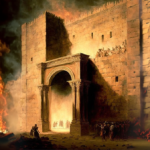

Parshat Bo features the final three of the ten plagues: locusts, darkness and the killing of the firstborn. What may be almost impossible for us to understand is Pharaohs’s consistent refusal to let the Jews go, the hardening of his heart and above all, his absolute denial that any of the plagues are the hand of Hashem. Even as his country, his people and his own health collapses, he never acknowledges the existence or power of Hashem. The cycle of promising to let the Jews go, regretting it, experiencing another plague and then begging Moshe to get rid of it seems almost childish or comical. Let’s explore this midda of Pharaoh, its dangers and its beauty across different contexts.
If we learn through the pesukim, we see that Pharaoh had every reason to eventually capitulate to Moshe’s request and let the Jewish people go. His kingdom descended into mayhem, his own sorcerers could not replicate even the lice unleashed onto the Egyptians (and they acknowledged “this is the finger of G-d”) – and not one member of the Jewish People was affected by the plagues. Yet in Yechezkel 29:3, the pasuk compares Pharaoh to a crocodile who says “My river is my own and I made myself.” Pharaoh’s arrogant hashkafa on life not only meant that he viewed the Nile as his personal property but that he believed he was a god, that he created himself. He hardened his heart completely against the possibility of there being a powerful Creator, arrogantly declaring “Who is Hashem that I should listen to Him?”
The Midrash Tanchuma (Vaeira 14:1) tells us that Pharaoh would awaken early to relieve himself so that no one would see. He boasted that since he was a god he had no need to relieve himself and therefore had to hide. Rashi elaborates (Yechezkel 29:3) that Pharaoh believed he didn’t need any Divine Assistance because he depended completely on the Nile which he worshipped as the source of everything. This is why the first plague was such a mighty blow in Egypt; truly hitting where it hurt most. The glorious Nile, once viewed as their source of life and sustenance, turned into a pool of bloody, pungent waters, absent of all fish and rendered useless.
Pharaoh was so blinded by his arrogance that according to Rabbi Avi Geller, despite seeing the reversal of nature as he knew it, witnessing the unfolding of layer after layer of creation, he believed that G-d was weak. Pharaoh convinced himself that since G-d apparently “needed” Pharaoh’s permission to free His people, He must be virtually powerless. Of course, this was far from the truth. In reality, Hashem wanted Pharaoh to officially release the Jews so that the Egyptians could never claim us back as their rightful slaves and ultimately, Pharaoh begged us to leave. Yet he cycled through the same obstinate, stubborn and almost laughable pattern ten times!
Pharaoh was so blinded by his arrogance that according to Rabbi Avi Geller, despite seeing the reversal of nature as he knew it, witnessing the unfolding of layer after layer of creation, he believed that G-d was weak. Pharaoh convinced himself that since G-d apparently “needed” Pharaoh’s permission to free His people, He must be virtually powerless. Of course, this was far from the truth.
On reflection, we can ask ourselves: where in our own lives has this midda of Pharaoh leaked in? Where are we being stubborn and hard-hearted?
Maybe we have an inflated view of what we control, like Pharaoh. Maybe we think that our husband’s spirituality, our children’s achievements (or lack of), lie solely in our hands. Maybe like Pharaoh, we continue making the same mistake over and over, running to Moshe to stop the plague and then running back to refuse. Maybe we communicate in the same old pattern with our spouse, only creating more friction or maybe we cling to the same rigid method to improve our child’s behaviour, even if the method doesn’t work for them.
Maybe we harden our hearts and write something off; believing that our introverted child just won’t make it socially or that our lack of cooking prowess means we can never enjoy hosting guests. If Hashem showed Pharaoh a miracle, he wouldn’t change. If the needs of our family changed, would we adapt our perfect plan? Would we make a shorter Shabbos meal if our spouse or child needed it? As Jewish women, we never want our heart to harden against our reality, but to soften and mold to our circumstances.
At the same time, as a Jewish nation in general, our stubbornness is both a blessing and a curse, a shortcoming and a virtue. We are called “am kshei oref” the nation of stiff necks. We are criticized by Hashem for being obstinate yet Moshe also pleads for our survival because of it, following the Egel. It isn’t clear from the pesukim whether being stiff-necked is a flaw that condemns us to destruction or arouses compassion for our salvation. Perhaps, it is both.
Rabbi Sacks quoted the powerful words of Rabbi Yitzchak Nissenbaum who explains Moshe’s appeal as follows:
“Almighty G‑d, look upon this people with favor, because what is now their greatest vice will one day be their most heroic virtue. They are indeed an obstinate people…But just as now they are stiff- necked in their disobedience, so one day they will be equally stiff-necked in their loyalty. Nations will call on them to assimilate, but they will refuse. Mightier religions will urge them to convert, but they will resist. They will suffer humiliation, persecution, even torture and death because of the name they bear and the faith they profess, but they will stay true to the covenant their ancestors made with You. They will go to their deaths saying Ani ma’amin, “I believe.” This is a people awesome in its obstinacy – and though now it is their failing, there will be times far into the future when it will be their noblest strength.” (paraphrased from itturei torah, Shemot)
So poignant are these words, spoken from a Rabbi who was killed in the Warsaw Ghetto.
Rabbi Sacks continues to bring sources for the praise of our stiff neckedness. The Gemara Beitza 25b quotes a Midrash (Shemot Rabba 42:9) which tells us there are three things which are impudent: the dog among beasts, the rooster among birds, and Israel among the nations. Rav Yitzchak ben Redifa said in the name of Rav Ami: You might think that this is a negative attribute, but in fact it is praiseworthy, for it means: “Either be a Jew or prepare to be hanged.” It is our chutzpa, which sounds so deplorable, which sustains us through the galut. Or in the poetic phrasing of Rabbi Sacks “Faced with G‑d’s presence, they disobeyed Him. Confronted with His absence, they stayed faithful to Him. That is the paradox of the stiff-necked people.”
Historically, it has always been the women who excelled in this trait; preserving their loyalty to Hashem through the toughest of times. Miriam Haneviah criticizing her father’s decree, the holy women beautifying themselves with mirrors and birthing children through the pains of Egyptian slavery. The daughters of Tzelafchad asking for land despite the trials of the desert, Ruth stubbornly following Naomi and Chana tenaciously davening for a child. Refusing to participate in the Egel, Shifra and Puah defying Pharaoh’s decree and Esther breaking the law to approach Achashverosh. Throughout the galut, Jewish women have clung to their spiritual resolve, never swaying from pressure within or without. May we be zoche to emulate this precious trait!
Related articles
 What Shabbat Teaches us About Jewish Vacation
- Is Self-Care Aligned with Torah Values?
- Yael: A Woman of Courage and Bravery
- Unpacking the Complex Concept of Minhag Hamakom
- A Closer Look at Eishet Chayil
- Re’eh: Tzedaka, the Feminine Way
- Comparing the Joy of Tu B’Av and Yom Kippur
- Serach: A Link to the Past
- The Folded Garment: Unveiling G-d’s Kindness
- The Inextricable Connection between Women and Eretz Yisrael










More articles by Tamara Klein
- Is Self-Care Aligned with Torah Values?
- Re’eh: Tzedaka, the Feminine Way
- Comparing the Joy of Tu B’Av and Yom Kippur
- Ekev: No One Will Stand Up Before You
- Tisha B’Av: The Secrets of Jewish Tears
- The Eyes, Windows of the Soul: A Torah Perspective on Crying
- Devarim and Tisha B’av: Turning Hatred into Love
- Chuldah: A Woman of Vision, Prayer and Prophecy
- Matot-Masei: The Significance of the Kohen Gadol’s Mother
- A Feminine Perspective on the 17th Tammuz