We are far removed from the days of the Beis Hamikdash—from the sacred מקום where korbanot were brought, where the Jewish People stood close to Hashem in a way we can barely imagine today. And yet, as Pesach approaches each year, we are invited back into that story. Not just to remember it—but to step into it.
Before the Jewish People ever left Egypt, something profound happened. Hashem turned to Moshe and Aharon and gave them their very first mitzvah as a nation: kiddush hachodesh—the sanctification of the new moon. Time itself was being placed into their hands. Nissan would now mark the beginning of the Jewish year. And then came the mitzvah that would define that month: The Korban Pesach1.
On the fourteenth of Nissan, each Jewish family was commanded to bring a korban. That very night, something world-altering would occur. Hashem would strike Egypt with makkat bechorot, killing every Egyptian firstborn. But in Jewish homes—there would be silence. Protection. Life. The Korban Pesach stood as a powerful line drawn in history: A clear, undeniable distinction between Jew and non-Jew.
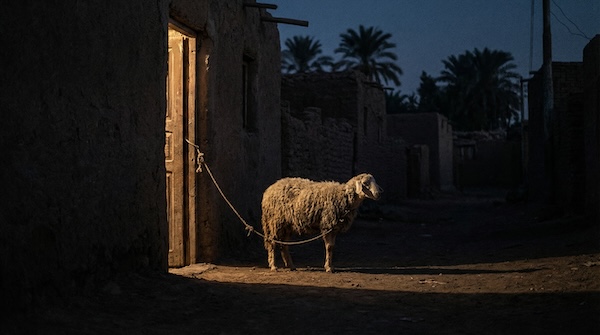
And then came the detail that made this mitzvah almost unthinkable. The animal chosen for the Korban Pesach was a lamb—the very creature worshipped as a deity by the Egyptians. Imagine it.
After generations of slavery, the Jews were commanded to take the Egyptian god… and slaughter it. Publicly. Fearlessly. In doing so, they weren’t just bringing a korban. They were making a declaration: This god has no power. Idolatry is empty.
We, too, live surrounded by influences that are not our own. And like them, we face a constant choice: What do we allow into our homes? Into our hearts? When we align ourselves with Jewish values, we show Hashem that we want closeness. That we choose Him.
It was an act of defiance—and of faith. And though it should have provoked Egyptian rage, it did the opposite. It became their protection2.
There was something else needed that night. Another mitzvah. Another act of courage. Brit mila.
No uncircumcised Jew was permitted to eat from the Korban Pesach3. And the blood of the mila was placed on the doorposts together with the blood of the korban.
But not everyone was ready. Some Jews hesitated. So Hashem created a moment they couldn’t ignore. Moshe was instructed to offer his korban immediately. And Hashem infused it with the heavenly fragrance of Gan Eden. The scent drifted through the camp—irresistible, otherworldly.
The people followed it. They came running.“What is that smell?” Moshe answered simply: Only those who perform brit mila may partake.
They needed no more convincing. And in a sweeping moment of unity and transformation, Moshe, Aharon, and Yehoshua circumcised the Jewish People4.
That night, something else was happening. Inside their homes, the Jewish People sat together, eating the Korban Pesach. Outside? Chaos. Death. Destruction. But they did not step out to watch. They stayed inside.
Because redemption isn’t just about being saved—it’s about who you choose to be. By remaining inside, they made a statement: We belong to our people. We reject the values of Egypt. And in doing so, they became worthy of freedom.
We, too, live surrounded by influences that are not our own. And like them, we face a constant choice: What do we allow into our homes?
Into our hearts? When we align ourselves with Jewish values, we show Hashem that we want closeness. That we choose Him.
The Korban Pesach had to be eaten in haste. Shoes on. Staff in hand. Like people about to leave. Because they were. After 210 years of brutal slavery, redemption came suddenly. Without warning. In a moment.
One second they were slaves. The next—they were free.
We know what it feels like to wait. To struggle and to wonder when relief will come. But the story of Pesach reminds us: Hashem’s salvation can arrive in the blink of an eye.
Hashem Himself carried out makkat bechorot. Because only He could truly know who was a firstborn5. And what was revealed that night was shocking.
In many Egyptian homes, more than one child died—exposing the widespread immorality of Egyptian society. Children born from infidelity were also considered firstborn.
It was a society where the sanctity of marriage had collapsed. And here, too, the message echoes forward. We live in a world where boundaries are blurred, where family and holiness are often not held sacred.
The responsibility falls on us: To protect the integrity of our homes. To build our own batei mikdash—spaces of purity, dignity, and kedusha.
After 210 years in Egypt, the Jewish People were deeply immersed in its culture. They didn’t have much merit. But through two acts—Korban Pesach and brit mila—they transformed themselves.They chose Hashem, and that choice made them worthy of redemption.
We, too, long for redemption.
And the path is the same: Learning Torah. Doing mitzvot. Acts of chessed. These are the choices that shape us into a people worthy of Mashiach.
We no longer bring the Korban Pesach, but its message is as alive as ever.It calls on us to be loyal to Hashem. To stand firm in our values. To remember that redemption can come at any moment.This year, as you sit at your Pesach seder, imagine that first night.The courage.The faith.The quiet inside the storm.
Remember our ancestors—who dared to act, to believe, to choose. And in their merit, were redeemed. May we, too, merit to hear the call of redemption— speedily, in our days. Amen.
Related articles
 Balance of Brotherhood: What We Can Learn from Rabbi Akiva’s Students
- The Omer: Counting Each Day and Making Each Day Count
- D’oraita vs. D’rabbanan: The Hidden Architecture of Halacha
- The Omer: A Long Chol Hamoed
- Embracing Health and Renewal: The Role of Women in Iyar
- One Day at a Time: The Spiritual Power of Counting the Omer
- The Halachot of Sefirat HaOmer
- Contrasting Women and the Sefira of Gevura
- The Omer and the Spirituality of Seven
- The Use of Symbolism on Leil HaSeder







More articles by Daniella Landau
- When I Stopped Taking Small Things for Granted
- Ruchie Freier: A Trailblazer in Law, Faith, and Community
- The Life and Legacy of Dr Edith Eger z”l
- Why Organ Donation Is So Close to My Heart
- The Kiss in Judaism
- What Is the Purpose of People with Mental Health Issues in this World?
- What Do the Ayatollah and Pharaoh Have in Common?
- Where Does the Shemonei Esrei Come From?
- The Unknown Side of Esther HaMalka
- Orpah: Standing at Crossroads, Making Evil Choices