
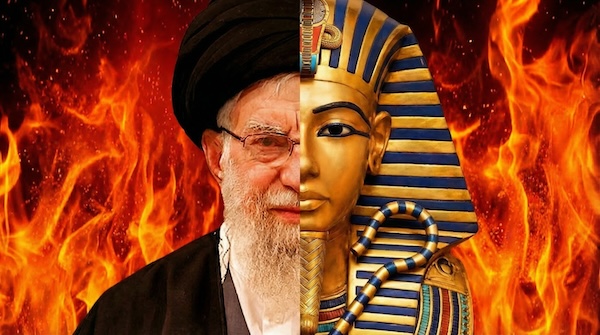
We find ourselves at a remarkable moment in world history. Through the hand of Hashem, the United States and Israel have been granted the strength to weaken the formidable Iranian regime and the evil it represents.As Pesach approaches, it is striking how powerfully today’s events echo the ancient story of our redemption. There are remarkable parallels between the wicked Ayatollah and the tyrannical Pharaoh of old. Reflecting on these similarities can help us better understand both the past and the present.
Pesach is the festival that celebrates freedom from oppression. The Jewish Nation had originally been invited to sojourn in the land of Egypt in order to survive the devastating famine that had struck Canaan. When Yaakov descended to Mitzrayim to reunite with his beloved son Yosef—whom he had not seen for twenty-two long years—he did so with full awareness of the bris bein habesarim. He understood that this journey marked the unfolding of that divine decree. Yet Yaakov and his sons went willingly, prepared to endure the trials of exile that Hashem had destined for them1.
As long as the Jews remained distinct from their Egyptian neighbors, they were protected. But when they abandoned the mitzvah of brit milah2 and began to imitate Egyptian practices such as sorcery and magic3, Hashem placed a new king over Egypt—one who viewed the Jewish People with suspicion and hostility. The Egyptians grew uneasy with their Jewish neighbors. Their property was seized4. Distrust grew into resentment, and resentment hardened into cruelty. Before long, relations deteriorated so severely that the Jewish People were forced into backbreaking slave labor5.
The oppression began not with chains, but with deception. Pharaoh—whose Hebrew name פרעה can be rearranged to form פה רע, “an evil mouth”—was a master of manipulation6. He dispatched royal criers through the Jewish neighborhoods of Egypt announcing ambitious plans to build new cities for Egypt’s expanding population. Great rewards were promised to those who volunteered for the construction effort. Enticed by these promises, the Jews joined the project and began producing bricks for the new cities.
At the end of the first day, however, the Egyptian taskmasters carefully counted the number of bricks each worker had produced. What had begun as voluntary labor instantly became a fixed quota7. By the time the Jews realized the trap, it was already too late—they were prisoners of the very work they had once believed to be an opportunity.
The Jews compared Egypt to horseradish—marror. A horseradish root begins soft and mild as it grows, but over time it hardens and becomes sharply bitter. So too had Egypt’s relationship with the Jewish People begun with kindness and hospitality, only to transform into ruthless oppression8.
The Egyptians also sought to ensure that the Jewish nation would not grow. They forced the men to labor through the night, keeping them away from their homes and families in a calculated effort to prevent the birth of Jewish children9.
In many ways, Khamenei can be compared to Pharaoh. Like the ancient tyrant, he ruled through intimidation and cruelty. He displayed open hostility toward Israel and the Jewish People and repeatedly sought their destruction. Yet history teaches a clear lesson: those who rise against the Jewish People ultimately face the consequences of their arrogance. Pharaoh ignored that lesson—and so did Khamenei.
To demonstrate His power to the disbelieving Egyptians, Hashem brought the ten miraculous plagues upon Egypt. Each makka revealed His absolute mastery over nature. The very Pharaoh who had arrogantly proclaimed, “Who is Hashem?” was ultimately brought to his knees, compelled to acknowledge the sovereignty of the Creator. The number ten itself carries deep significance: the world was brought into existence through ten divine utterances10. Pharaoh denied the Creator and the world He fashioned, and so Hashem punished him through ten wondrous plagues that shattered his illusion of power11.
As we prepare our homes and hearts for Pesach, we find ourselves living through a time of conflict with a cruel enemy. Ali Khamenei was notorious for his brutality—both toward his own people and toward others. Protesters who dared challenge his regime were arrested, tortured, or killed. Iran has one of the highest execution rates per capita in the world, with many victims being minorities or political prisoners. Freedom of speech was tightly restricted. Journalists were frequently imprisoned or silenced. Basic rights were heavily curtailed, and many citizens lived under constant fear.
In many ways, Khamenei can be compared to Pharaoh. Like the ancient tyrant, he ruled through intimidation and cruelty. He displayed open hostility toward Israel and the Jewish People and repeatedly sought their destruction. Yet history teaches a clear lesson: those who rise against the Jewish People ultimately face the consequences of their arrogance. Pharaoh ignored that lesson—and so did Khamenei.
We are living in frightening yet extraordinary times. When the sirens sound and people run for shelter, it is worth remembering how many enemies of the Jewish People have risen throughout history—only to vanish, while the Jewish nation endures. As we proclaim in the Haggadah: “In every generation they rise up against us to destroy us, but Hashem saves us from their hands.”12
Just as Hashem protected the Jews in Egypt, He continues to protect the Jewish People in Israel and throughout the world. Just as the Jews in Mitzrayim held firmly to their emunah, so must we. Just as they remained faithful to Hashem, so must we. And just as they never despaired of redemption, so must we never lose hope.
Hashem sent Moshe to redeem the Jewish People from Egypt, and He will send Moshiach to gather the Jewish nation from every corner of the globe. May the piercing wail of sirens warning of incoming missiles soon be replaced by the powerful blast of the shofar announcing the arrival of Moshiach.
- Ohr Hachaim Shmos 1:1 ↩︎
- Shmos Rabba 1:8 ↩︎
- Hagadas Ritva ↩︎
- Sefer Hayashar ↩︎
- Ohr Hachaim Shmos 1:6 ↩︎
- Haggodas Zevach Pesach ↩︎
- Midrash Hagadol, Shmos Alef ↩︎
- Pesachim 39. ↩︎
- Eliya Rabba 7 ↩︎
- Pirkei Avos 5:1 ↩︎
- Lekach Tov vaeira 9:13 ↩︎
- Pesach haggoda ↩︎
Related articles
 Balance of Brotherhood: What We Can Learn from Rabbi Akiva’s Students
- The Omer: Counting Each Day and Making Each Day Count
- D’oraita vs. D’rabbanan: The Hidden Architecture of Halacha
- The Omer: A Long Chol Hamoed
- Embracing Health and Renewal: The Role of Women in Iyar
- One Day at a Time: The Spiritual Power of Counting the Omer
- The Halachot of Sefirat HaOmer
- Contrasting Women and the Sefira of Gevura
- The Omer and the Spirituality of Seven
- The Use of Symbolism on Leil HaSeder







More articles by Daniella Landau
- When I Stopped Taking Small Things for Granted
- Ruchie Freier: A Trailblazer in Law, Faith, and Community
- The Life and Legacy of Dr Edith Eger z”l
- Why Organ Donation Is So Close to My Heart
- The Kiss in Judaism
- What Is the Purpose of People with Mental Health Issues in this World?
- On the Eve of Redemption: The Story of the Korban Pesach
- Where Does the Shemonei Esrei Come From?
- The Unknown Side of Esther HaMalka
- Orpah: Standing at Crossroads, Making Evil Choices