
Many of us have learned about the miracle of the manna, the Heavenly food which sustained us through our 40 years of wandering through the desert. We know from the pesukim what the manna looked like, what it could taste like, even how the people prepared and collected it. What we perhaps never learned is the words of the Gemara which tells us that together with the manna, jewellery and perfume descended from Heaven for the women. Here we will delve into the sources outlining what Hashem gave the women, why He sent it and deepen our understanding of the Torah’s view on Jewish women and their physical appearance.
The Gemara in Yoma 75a tells us that jewellery and perfume descended for the people. The Gemara brings its proof from the pasuk1 in the Torah which references beating the manna in a mortar. The Gemara explains that this was perfume as women would need to beat the pleasant spices in a mortar to produce the fragrance.
In a similar way, the Gemara derives the proof for the jewellery from a pasuk2 about donations for the Mishkan where the Torah writes that they brought their contributions each morning. The Gemara extrapolates from here that their contributions to the Mishkan came from the manna, which fell every morning, showing that pearls and other precious stones descended with the manna. The pasuk3 specifically highlights that the nesiim, the leaders of each tribe, brought the avnei shoham, the stones for the Choshen. The Gemara uses the word nesiim, which also means clouds, (as in Mishlei 25:14) to say that the clouds brought the avnei shoham. It was the clouds, the source of the falling manna, which provided these beautiful gems.
The Ben Ish Chai (Ben Yehoyada) interprets the Gemara in a different way and writes that the gemstones and perfumed spices which the Gemara mentions are far from physical. He explains that although generally women beautify themselves with makeup and perfume, during the time they ate the manna this was not necessary. The manna was not just an experience of physical sustenance or even enjoyment, but spiritual elevation. So pure was the manna that it lit up the faces of each Jewish woman so they glowed with enhanced beauty and produced a sweet scent, transcending even the most fragrant of perfumes. In Tehillim (78:25), David Hamelech calls the manna ‘lechem abirim’ which Rashi translates as ‘bread of the angels.’ The manna may have sated their appetites physically, but it was entirely spiritual, to the extent that Rashi describes how it did not produce any bodily waste. Much like in Gan Eden where Adam and Chava did not need clothes and were enrobed in light, the Jewish women did not need physical jewels as they were shining from within.
We see a similar phenomenon in Megilat Esther when the pasuk (2:12) describes how each woman underwent 12 months of cosmetic treatments before being presented to Achashverosh as potential queen. “Six months with oil of myrrh and six months with perfumes and women’s cosmetics.” The pasuk refers to a literal beauty treatment, however, commentators such as the Gra and Rav Schneur Zalman of Liadi add a layer of spiritual depth. Each compares the periods of six months to an act of spirituality such as focusing on one’s aveirot and contemplating Hashem. The physical beauty treatments thus act as a mashal for the greatest act of spiritual beauty treatment – teshuva. Spiritual beauty shines through the Torah through the vehicle of physical beauty.
The beauty of the Jewish woman, like the beauty of Yerushalayim, is the key to growth in Torah and yirat shamayim. May we merit to use the power of our physical beauty with wisdom.
However, Rashi interprets the Gemara as literal. Rashi writes that the spices which the women ground into the perfume in the midbar were designed to ensure that the women smelt pleasant for their husbands in the desert. In this barren wilderness, stripped of everything but necessities, Hashem ensured that the Jewish women had the resources they needed to tend to their physical appearance, enhancing the relationship between husband and wife. Even in the desert, the Torah considers woman’s beauty a value of utmost importance and is cared for just like our need for food, water and shelter. Physical beauty, when invested for the sake of a woman elevating herself and enhancing herself for her husband is not empty or materialistic, it is one of the holiest acts she can do for herself and her marriage.
Rav Avigdor Miller emphasized the importance of a Jewish woman tending to her physical appearance, quoting the takana of Ezra Hasofer. Ezra established a list of takkanot to ensure the spiritual survival of the Jewish people when he brought them back to Eretz Yisrael. Incredibly, one of his takanot was that peddlers of women’s cosmetics should visit every town once a week. Among this holy tzaddik’s list of priorities for the nation was that Jewish women should take care of themselves physically and have access to beauty products, every week.
Similarly, Chacham Yaakov Hillel quotes the Gemara4 “A woman is only for beauty. A woman is only for childbearing… A woman is only for women’s ornaments.” This Gemara may sound shocking or even disparaging without proper understanding and Chacham Hillel frames it in a powerful context. The Midrash5 tells us that before the flood men would take two wives; essentially, one for pleasure (beauty) and one for practical (childbearing). The wife who bore children would be drowning in housework, dressed like a drudge while the other wife could pamper and adorn herself, after drinking a beverage which caused barrenness. This split system is not the Torah way and this is what the Gemara clarifies. A woman is both the akeret habayit steeped in dishes and laundry and the beloved wife, looking pleasant and attractive for her husband. It is the two together which creates the Torah’s definition of the majestic and modest female beauty.
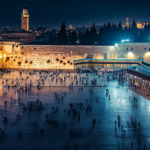
We may be used to hearing ‘hevel hayofi’ that beauty is emptiness, but that is only for a woman who lacks yirat shamayim. A G-d fearing woman knows that beauty lies not only in the spiritual plane, but the physical one as well. Rabbi Frand quotes the Gemara that three things expand the mind of a man6: a beautiful house, beautiful possessions and a beautiful wife. Rabbi Frand compares this to the Gemara7 which states that 10 measures of beauty descended to the world and Yerushalayim took nine. Yerushalayim is the holiest city on earth, yet the Torah emphasises its physical beauty. Rabbi Frand explains that when one’s surroundings are beautiful, a person is more receptive to kedusha. For a man to have a beautiful wife is not to worship the physical but to use it to elevate him to greater spiritual heights.
The beauty of the Jewish woman, like the beauty of Yerushalayim, is the key to growth in Torah and yirat shamayim. May we merit to use the power of our physical beauty with wisdom.
- Bamidbar 11:8 ↩︎
- Shemot 36:3 ↩︎
- 35:27 ↩︎
- Ketubot 59b ↩︎
- Bereshit Rabba 23:2 ↩︎
- Brachot 57b ↩︎
- Kiddushin 49b ↩︎
Related articles
 Ani Le’Dodi V’Dodi Li: Doing Teshuva Out of Love
- Ki Teitzei: The Non-Jewish Woman Captive
- Delilah: A Wife Can Either Uplift Her Husband or Cause His Downfall
- Unveiling the Mystery of the Sotah
- What is a miracle and how are we supposed to interact with it nowadays?
- Why Is Rosh Chodesh Attributed to Women?
- Diverging Opinions on Head Covering
- Sarah: Beauty According to the Torah
- A Feminine Perspective on the Shofar
- Contrasting Women and the Sefira of Hod





More articles by Tamara Klein
- What Makes a Good Year? The Secret to a Successful Rosh Hashanah
- Nitzavim-Vayelech: Circumcision of the Heart
- Selichot: Peeling Away the Layers Over Our Hearts
- Ki Tavo: How to Battle Against Sichon
- Ki Teitzei: The Non-Jewish Woman Captive
- Is Self-Care Aligned with Torah Values?
- Re’eh: Tzedaka, the Feminine Way
- Comparing the Joy of Tu B’Av and Yom Kippur
- Ekev: No One Will Stand Up Before You
- Tisha B’Av: The Secrets of Jewish Tears