
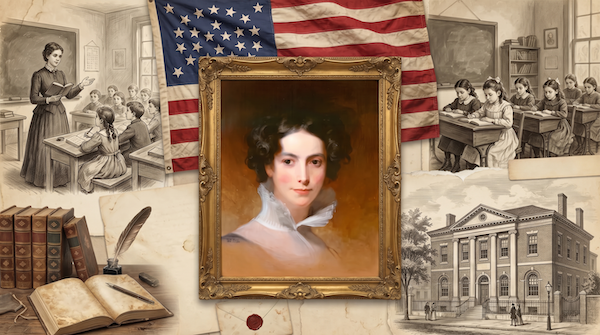
In early nineteenth-century America, Jews enjoyed opportunities that many of their European ancestors could scarcely have imagined. They could participate in wider society, establish businesses, and build friendships across religious boundaries. Yet this freedom brought a new challenge: in a predominantly Christian society, how could Jewish parents ensure that their children remained connected to Judaism?
Rebecca Gratz believed the answer lay in education. At a time when organized Jewish schooling was scarce, particularly for girls, she helped establish an institution that would make Jewish learning accessible to children regardless of their families’ financial circumstances.
A Jewish Woman in American Society
Rebecca Gratz was born in Lancaster, Pennsylvania, in 1781, into a prominent observant Jewish family. Her father, Michael Gratz, was a successful merchant, and the family was deeply involved in Jewish communal life.
Growing up in Philadelphia, Rebecca received an extensive education and moved comfortably among the city’s social elite. She developed close friendships with Christians, participated in charitable organizations, and was widely respected for her intelligence and generosity.
Yet her involvement in American society did not weaken her Jewish identity. She remained attached to Philadelphia’s Congregation Mikveh Israel and developed a deep interest in Jewish literature, despite her limited knowledge of Hebrew.
Gratz understood that maintaining a Jewish identity required more than simply being born Jewish. Children needed opportunities to learn about their religion and understand what distinguished it from the beliefs surrounding them.
When Charity Came with Religious Expectations
Gratz began her charitable work at a young age. In 1801, she helped establish the Female Association for the Relief of Women and Children in Reduced Circumstances, which assisted impoverished families regardless of religion.
Through her charitable activities, she became increasingly aware of the difficulties facing poor Jewish families. Many institutions offering assistance were associated with Christian religious movements, and some combined charitable work with missionary efforts.
For struggling Jewish families, this created a dilemma. They needed help, but accepting it could expose their children to unwanted religious influences.
In 1819, Gratz helped establish the Female Hebrew Benevolent Society, which provided assistance to Jewish families in need. Her guiding principle was that Jews should not have to compromise their religious identity to receive support.
But she increasingly recognized that material assistance alone was insufficient. Jewish children also needed an education.
A New Approach to Jewish Education
During the early nineteenth century, Jewish education in America was limited. Some children learned at home or with private teachers, but many received little formal religious instruction. Girls were particularly likely to miss out.
Meanwhile, Christian Sunday schools were becoming increasingly popular, offering children free religious education. Gratz recognized the effectiveness of this model and believed Jewish communities could establish something similar.
One of the most significant aspects of Gratz’s educational philosophy was her emphasis on understanding. Gratz believed that children who understood their religion would be better equipped to respond. She wanted them not merely to inherit Jewish practices but to appreciate their meaning and develop confidence in their identity. She knew that Jewish children would inevitably encounter people whose religious beliefs differed from their own. They might be questioned about Judaism or exposed to missionary arguments.
She envisioned a school where boys and girls could learn about Judaism in English, without their parents having to pay tuition or belong to a particular synagogue.
In 1835, she publicly advocated for stronger Jewish education. Three years later, on March 4, 1838, the Hebrew Sunday School Society opened in Philadelphia.The school offered free instruction in Jewish beliefs, prayers, history, and religious practices. Gratz worked closely with Isaac Leeser, a leading figure in American Judaism, who helped develop educational materials and encouraged similar initiatives elsewhere.
The school began with approximately fifty pupils, but its influence soon spread beyond Philadelphia.
Knowing Why They Were Jewish
One of the most significant aspects of Gratz’s educational philosophy was her emphasis on understanding.
She knew that Jewish children would inevitably encounter people whose religious beliefs differed from their own. They might be questioned about Judaism or exposed to missionary arguments.
Gratz believed that children who understood their religion would be better equipped to respond. She wanted them not merely to inherit Jewish practices but to appreciate their meaning and develop confidence in their identity.
Importantly, she did not believe that preserving Judaism required withdrawing from American society. Rather, Jewish children needed the knowledge to participate fully in that society without losing their religious heritage.
Creating Opportunities for Jewish Women
Gratz’s achievements were particularly remarkable given the limited leadership opportunities available to women in nineteenth-century America.
Charitable organizations provided women with opportunities to organize activities, raise funds, manage institutions, and exercise responsibility. Gratz made extensive use of these opportunities.
The Hebrew Sunday School Society went further by placing women at the center of Jewish education. Women served as teachers, helped develop lessons, and assumed responsibility for transmitting Jewish knowledge to the next generation.
Gratz also encouraged Jewish women in other cities to establish similar schools, helping create a model of female leadership in Jewish education.
Caring for Children Beyond the Classroom
Gratz’s concern for Jewish children extended beyond education. She also worried about orphans and children whose families could not care for them.
Having worked for decades with the Philadelphia Orphan Asylum, she understood that Jewish children raised in Christian institutions risked losing their connection to Judaism.
In 1855, she helped establish the Jewish Foster Home in Philadelphia, providing vulnerable Jewish children with care in an environment that respected their religious identity.
It reflected the same principle that guided her educational work: Jewish children deserved both practical support and the opportunity to remain connected to their heritage.
A Lasting Legacy
Rebecca Gratz never married, but she remained closely involved with her extended family while dedicating much of her life to charitable and educational work. She died in 1869, aged eighty-eight.
The institutions she helped establish became models for Jewish education and welfare. In 1895, Gratz College was established in Philadelphia through a bequest from her brother Hyman, becoming an important center for Jewish education and teacher training.
The challenge she confronted remains familiar to us today. How can Jewish children develop a meaningful connection to their heritage while participating fully in the societies around them?
Rebecca Gratz believed that the answer began with education: giving children the knowledge to understand their Judaism, the confidence to value it, and the desire to carry it forward.
Related articles
 Eidel Pappenheim-Dubin: A Forgotten Pioneer of Jewish Women’s Leadership
- My Experience with Special Needs Individuals
- Ani Le’Dodi V’Dodi Li: Doing Teshuva Out of Love
- The Company That Shapes Us
- A Closer Look at Eishet Chayil
- The Missing Conversation in Women’s Torah Media is Tzofia.org
- Flora Sassoon: India’s Scholar and Businesswoman
- A Married Woman Taking On Her Husband’s Customs
- Sarah Schenirer: The Woman Who Revolutionized Jewish Girls’ Education
- The Women of Shavuot: Torah Through the Eyes of Chutzpah Girls








More articles by Riva Kent
- Is Inspiration a Torah Concept?
- What Does It Mean to Be Rich?
- Beyond Yom Kippur: Making Change Last
- Understanding the Concept of Serving Hashem with Joy
- What Is the Connection between Sukkot, Simcha and Olam HaBa?
- How Not to Get Plagued by Guilt When It Comes to Teshuva
- A New Reading of the Book of Life
- The Interconnection between Rosh Hashana and Yom Kippur
- Ani Le’Dodi V’Dodi Li: Doing Teshuva Out of Love
- “Circle, Arrow, Spiral”: The Dynamics of Change and Acceptance in Teshuva