
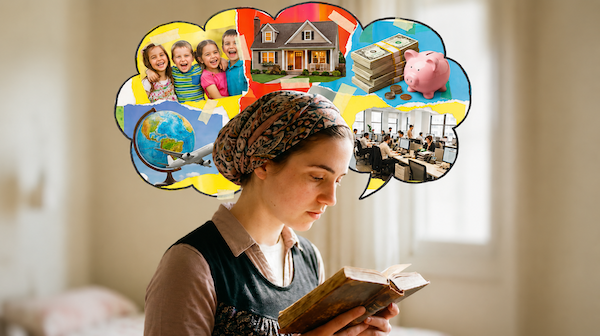
Everyone wants a good year. The Shabbat before Rosh Hashanah the Torah outlines the choices clearly:
‘See I have placed before you today life and good and death and bad.’ (Devarim 30:15)
Hashem tells us that if we follow His will and keep Torah, we will experience life and goodness. But if we turn away from Him, we will bring bad upon ourselves. The choice is in our hands.
We come to Rosh Hashanah with our list. Children. Parnassa. Health. Shidduchim. But do we truly know what makes a good year?
The pasuk in Devarim (17:11) tells us ‘According to the judgement that they tell you, you should do. Do not deviate from anything they tell you, right or left.” The Torah instructs us that whatever decision is rendered by a judge, we should follow it exactly. Rashi extends this idea and writes that even if the judge says right is left, we should follow it.
This sounds hard to believe. How can the Torah tell us to trust someone’s ruling if they are calling the right, left? Rav Moshe Tzvi Weinberg1 answers that the right and the left represent the two modes through which Hashem interacts with the world: rachamim (mercy) and din (judgement). We are not always capable of distinguishing between the two. What looks good to us, may be Hashem exacting din and what looks bad to us may be a hidden act of rachamim. We are told to trust our chachamim because we do not have this clarity. We do not know what a good year is for us.
Elul is the start of this journey and shemini Atzeret is the culmination. Rashi tells us that the Yom Tov of shemini atzeret was created because Hashem says ‘kashe alay preidaschem’ ‘it is hard for me to separate from you.’ Hashem wants one more day, one more yom tov, one more embrace. But on a deeper level, why would one more day of togetherness help if Hashem does not want to separate? It must be that the yom tov of shemini atzeret bonds us with Hashem in a way that there is no more separation. We reach the status of shivti b’veit Hashem, dwelling in Hashem’s home, and we never want to leave.
There is only one certainty we have and this is what David Hamelech wrote so beautifully in Tehillim (27:4) ‘One thing I have asked of Hashem, that I will request for me to sit in the House of Hashem…’
Rav Asher Weiss notes that two tenses are used in this request ‘I asked’ and ‘I will request.’ He explains powerfully that through the different waves of life, people have different aspirations and desires. Some things we ask for when we are young, some when we are old. Some we need when we are poor, others when we are rich. But David Hamelech who began life as a simple shepherd and became the King of the Jewish people never wavered in this request. This aspiration never changed. His desire to dwell in Hashem’s House.
We don’t know what our year will look like. We don’t know the ups and downs over the various cycles of our lives. But the one constant we can hold onto is dwelling in the House of Hashem. This is what gives us calm and this is our reassurance for a good year.
What does it mean to dwell in Hashem’s house? Rav Elchonon Jacobovitz describes it as arriving at the realization that Hashem’s house is more real to me than my own. What is a bayit? It is my familiar place, my comfort zone. It is the place I love, the place I just want to come to at the end of a long day. It has the decor I like, the vibe that makes me happiest. As women, we create the emotional tone of the home, we know what it means for a child to feel comfortable in their bayit. To create an ambience of connection with our husband in our home. This is how we can be with Hashem.
The depth of the introspection, the intense tefillot and selichot, the frightening Unetaneh Tokef and the heartfelt vidui of this period is all to lead up to dancing with Hashem on Simchas Torah and living in seclusion with Hashem forever onward. The intimacy with Hashem is what it is all for. Elul famously contains this secret in its name as an acronym for ani ledodi vedodi li, I am for my beloved and my beloved is for me. Through our teshuva, we build a private home with Hashem. And we want to dwell in that home forever.
Elul is the start of this journey and shemini Atzeret is the culmination. Rashi tells us that the Yom Tov of shemini atzeret was created because Hashem says ‘kashe alay preidaschem’ ‘it is hard for me to separate from you.’ Hashem wants one more day, one more yom tov, one more embrace. But on a deeper level, why would one more day of togetherness help if Hashem does not want to separate? It must be that the yom tov of shemini atzeret bonds us with Hashem in a way that there is no more separation. We reach the status of shivti b’veit Hashem, dwelling in Hashem’s home, and we never want to leave.
Once we are in Hashem’s home, Hashem’s arms so to speak, we no longer need to worry about our year because this is all we truly want. This is what our whole request list is for. This is our guarantee for a Shana Tova.
- Based on the Sefer Degel Machane Ephraim, in a shiur ↩︎
Related articles
 Is Independence a Torah Value?
- What Does It Mean to Be Rich?
- What Is Dat Moshe?
- Beyond Yom Kippur: Making Change Last
- Simchat Torah: Happy Wife, Happy Life!
- My Experience with Special Needs Individuals
- Elul: A Time to Work on Relationships
- Malchut: Revealing the Feminine Energy on Rosh Hashanah
- Ki Tavo: How to Battle Against Sichon
- Forgiveness Lessons from the Story of Yosef










More articles by Tamara Klein
- Sukkot: Insights on the Four Species
- Rosh Hashanah: The Deeper Meaning of the Shofar
- Serach: A Link to the Past
- The Omer: Counting Each Day and Making Each Day Count
- Elul: Teshuva, a Divine Gift
- The ABCs of Prayer
- Miriam: A Prophetess and a Leader
- Tamar: A Selfless Hero
- Ruth: The Paradigm of Lovingkindness
- Torah: Our Map, Our Milk