
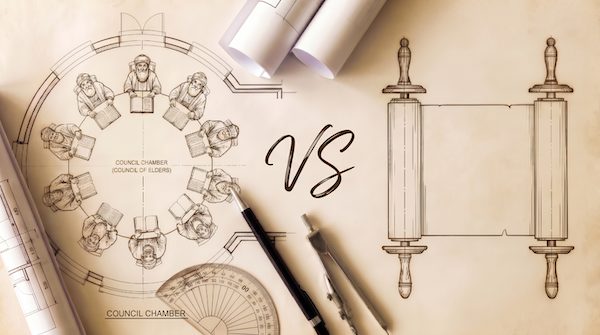
At the heart of halacha lies a distinction that shapes everything: d’oraita (“from the Torah”) and d’rabbanan (“from the Rabbis”). On the surface, it sounds simple — one is Divine, the other rabbinic. But beneath that simplicity is a surprisingly dynamic system, where these two layers work together to create something both eternal and alive.
D’oraita laws are the unshakable core. D’rabbanan laws are the system that protects, applies, and sustains that core in real life. Both are binding. Both are essential. And understanding how they interact opens a window into how halacha actually works — not just as law, but as a living framework.
The Core: D’oraita
D’oraita laws are what we usually think of as “the mitzvot” — the Torah’s direct commands. Keeping Shabbat, eating matzah on Pesach, avoiding certain prohibitions — these aren’t just practices; they are expressions of Divine will itself.
But their role goes deeper than individual obligations. D’oraita laws define the structure of Jewish life. They set the boundaries of what is allowed and what is forbidden. They create rhythm and framework—the blueprint from which everything else in halacha develops.
In this sense, d’oraita laws do more than command behavior; they define the contours of meaning itself. They determine what counts as sacred time, sacred action, and sacred restraint. Without this fixed center, halacha would lose its coherence, and its boundaries would begin to blur into something endlessly negotiable.
The Living Layer: D’rabbanan
Alongside that foundation, a second layer develops: laws established by the Rabbis throughout history.
At first glance, this might seem like a human addition — but the Torah itself builds this into the system:
עַל־פִּי הַתּוֹרָה אֲשֶׁר יוֹרוּךָ וְעַל־הַמִּשְׁפָּט אֲשֶׁר־יֹאמְרוּ לְךָ תַּעֲשֶׂה לֹא תָסוּר מִן־הַדָּבָר אֲשֶׁר־יַגִּידוּ לְךָ יָמִין וּשְׂמֹאל׃
“According to the Torah that they will instruct you, and according to the judgment that they will tell you, you shall act. You must not deviate from the word that they tell you—neither to the right nor to the left.” (Devarim 17:11)
In other words, the Torah didn’t just give laws — it created a process. It empowered the Rabbis to interpret, apply, and even legislate when necessary. Not as innovators replacing the Torah, but as guardians ensuring it can actually function in the real world.
These rabbinic laws generally fall into three types:
- Protective fences (gezeirot): Safeguards that keep us from getting too close to a violation. If the Torah marks the edge of a cliff, the Rabbis build the fence several steps back. For example, the Torah prohibits melacha on Shabbat—but the Rabbis extend that boundary by prohibiting certain actions that might easily lead to it, like handling items that are muktzeh. The idea isn’t to add new “forbidden territory,” but to make sure we never even drift close to crossing the line in the first place.
- Structural systems (takanot): Frameworks that make Jewish life consistent and sustainable. For example, fixed daily prayer times weren’t commanded in the Torah, but without them, prayer could easily become irregular or neglected.
- Commemorations: Practices that preserve memory and identity—like Chanukah candles or reading the Megillah on Purim—embedding history into everyday life.
In short:
Gezeirot → preventing boundary erosion over time
Takanot → creating stable communal infrastructure
Commemorations → turning historical memory into lived identity
Where It Really Matters
This distinction isn’t just theoretical—it affects real decisions.
When there’s uncertainty, halacha responds differently depending on the level. A doubt involving a Torah law is treated strictly (safek d’oraita l’chumra). A doubt involving a rabbinic law is treated more leniently (safek d’rabbanan l’kula).
Together, they form a single system in which eternity and adaptability are not competing forces but mutually dependent ones. The fixed word of d’oraita gives halacha its identity, while the responsive development of d’rabbanan gives it continuity across time. Without either, the system would collapse—either into rigidity that cannot be lived, or flexibility that loses definition.
D’oraita laws take precedence over d’rabbanan laws, reflecting their higher level of authority. The reason is not simply that one is “stronger,” but that d’oraita represents the fixed coordinates of the system, while d’rabbanan operates within that space. When the two appear to conflict, halacha preserves the integrity of the coordinates first, and then works within them using the flexibility of rabbinic law.
For instance, although Chanukah candles are ideally lit at nightfall, they cannot be lit on Shabbat, since lighting a flame is a Torah prohibition. As a result, the mitzvah is pushed either before Shabbat begins (on Friday) or after it ends (on Saturday).
More broadly, when the two categories come into tension, Torah laws set the fixed boundaries, while rabbinic laws operate within them with greater flexibility, especially in situations of need. This reflects their role as responsive, practical tools rather than fixed absolutes.
Not Two Systems—One
It’s tempting to think of d’oraita and d’rabbanan as separate tracks. They’re not. They’re two layers of a single system.
The Torah provides the foundation. The Rabbis ensure that foundation can be lived.
This idea comes to life in a famous story from the Gemara (Bava Metzia 59b). In a legal debate, Rabbi Eliezer supports his position with miraculous signs and even a heavenly voice to prove he’s right. And yet, the other Rabbis reject these proofs. Why?
Because, as Rabbi Yehoshua declares: “Lo bashamayim hi” — “The Torah is not in Heaven.”
Once the Torah was given, its interpretation was entrusted to human beings. Not even a voice from Heaven overrides the halachic process. The Divine gives the framework, but human sages bring it into reality.
A Partnership, Not a Divide
So the distinction between d’oraita and d’rabbanan isn’t a hierarchy that separates, it’s a partnership that sustains.
D’oraita anchors halacha in something absolute and unchanging. D’rabbanan ensures it remains livable, relevant, and protected.
Together, they form a single system in which eternity and adaptability are not competing forces but mutually dependent ones. The fixed word of d’oraita gives halacha its identity, while the responsive development of d’rabbanan gives it continuity across time. Without either, the system would collapse—either into rigidity that cannot be lived, or flexibility that loses definition.
Related articles
 Lech Lecha: The Significance of a Name Change
- Beyond Yom Kippur: Making Change Last
- Why Can’t a Woman Be a Judge?
- Can Artificial Intelligence Replace a Rabbi?
- A Woman Spy: Where Halacha and Bravery Meet
- Pregnancy and Fasting on Yom Kippur
- The Halachic Ramifications of a Woman Spy: Where Bravery and Halacha Meet
- Forgiveness Lessons from the Story of Yosef
- Ki Teitzei: The Non-Jewish Woman Captive
- Unpacking the Complex Concept of Minhag Hamakom










More articles by Riva Kent
- What Does It Mean to Be Rich?
- Beyond Yom Kippur: Making Change Last
- Understanding the Concept of Serving Hashem with Joy
- What Is the Connection between Sukkot, Simcha and Olam HaBa?
- How Not to Get Plagued by Guilt When It Comes to Teshuva
- A New Reading of the Book of Life
- The Interconnection between Rosh Hashana and Yom Kippur
- Ani Le’Dodi V’Dodi Li: Doing Teshuva Out of Love
- “Circle, Arrow, Spiral”: The Dynamics of Change and Acceptance in Teshuva
- The Company That Shapes Us