
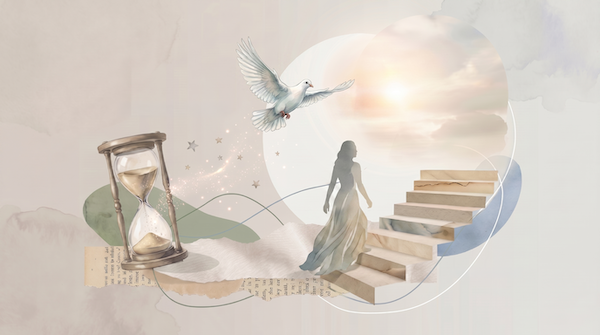
A few days ago, I lost my great aunt at the advanced age of 96 years old, who was like a grandmother to me. She had an emuna in Hashem and the tzaddikim that most would envy, and a contagious joy of life. In my 30 years of existence, this was my first real encounter with the passing of a loved one. Beforehand, death was something foreign to me, and I feel privileged this has been so. I sadly did not have the chance to attend the levaya in person as I moved to Israel nearly 9 years ago from Montreal, and my great aunt was still living there. I was at least able to watch it live through video, and her death hit me like a hammer.
A person is here one day and the next, they are no longer. We have a sense of eternity, that tomorrow we will wake up in the morning, and then all of a sudden, we are no more, merely forgotten. On the one hand, this is a humbling experience. On the other hand, this frightened me to the core. The feeling of losing loved ones, of no longer being able to talk to them, to connect with them. Having these thoughts made me profoundly sad, and I felt a terrible sense of emptiness and void.
One of the most fundamental tenets of Judaism is the concept of Olam Haba, the next world. In fact, we are told that the entire reward for mitzvot is in the next world, not in this one. We are meant to immerse ourselves in the pleasures of this world, but with the knowledge and awareness that the next world is the ikar, the most important part of it all.
If this life is temporary, if Hashem only placed us in here for a short amount of time, then what is the meaning of death, how should we live, and what is the purpose?
A person is here one day and the next, they are no longer. We have a sense of eternity, that tomorrow we will wake up in the morning, and then all of a sudden, we are no more, merely forgotten. On the one hand, this is a humbling experience. On the other hand, this frightened me to the core. The feeling of losing loved ones, of no longer being able to talk to them, to connect with them.
The Gemara1 tells the story of a pious man who once gave a coin to a poor man on Erev Rosh Hashanah. Upon returning home, the pious man told his wife of his gesture, and they being poor themselves, the wife got upset at him for giving away the little money that they had. The pious man got vexed and decided to spend all night in a cemetery. Rav Yisrael Salanter asks: Why in the world was this man doing in a cemetery on Erev Rosh Hashanah?! When the pious man got reprimanded by his wife, he became a little angry. All year he had worked on his greatness, and now he felt like he was falling out of it. To erase anger from his heart, he felt he needed an emergency measure on Erev Rosh Hashanah, and thus off to the cemetery he went.
Another Gemara2 says that if a man sees that his Yetzer Hara is overcoming him, he should try different measures. If the first one doesn’t help, then he should go to the next one, and the next one. And if he is still trapped, the last resort is: “Think of the day of death”. That is why this pious man went to the cemetery. He told himself: “Look, you’re gonna die anyway, is it worth getting angry? Your body will be buried 6 feet underground.”
But one may ask, if thinking of the day of death is so effective, why didn’t the Gemara recommend this method first, rather than as a last resort?
Rav Avigdor Miller3 answers: Because death is not what Hashem wants us to think about. The Sages didn’t recommend thinking about death because this can cause us to feel incredibly sad, even depressed. Hashem wants us to be b’simcha. “We cannot function unless we lubricate the machinery of our characters, of our emotional traits, of our mentality, and the lubrication is simcha.”4
In order to be a true eved Hashem, one must cultivate his level of simcha, by having pleasant thoughts and focusing on all the good he or she has in his life.
So what is the point of it all? I believe the point of it all is to live a fulfilling and meaningful life, and to make the most of every minute. To live a connected life, and by that I mean connected to Hashem, to Torah, and to oneself. For that is the only way to ensure that our days were spent wisely, happily, and meaningfully. May we all merit such a life, until 120, in great joy and with the least suffering possible!
In loving memory of Arlette Radua Bat Abba
Related articles
 Is Independence a Torah Value?
- A Woman Spy: Where Halacha and Bravery Meet
- Blowing the Shofar: Confusing the Satan?
- What Makes a Good Year? The Secret to a Successful Rosh Hashanah
- Ki Teitzei: The Non-Jewish Woman Captive
- Yael: A Woman of Courage and Bravery
- The Folded Garment: Unveiling G-d’s Kindness
- The Inextricable Connection between Women and Eretz Yisrael
- Lala Soulika: Dying for the Sake of Tzniut
- Ekev: No One Will Stand Up Before You









More articles by Liora Rosenblatt
- Malchut: Revealing the Feminine Energy on Rosh Hashanah
- Lala Soulika: Dying for the Sake of Tzniut
- Megillat Ruth: The Halachic Roadmap for Welcoming Converts
- Are Men and Women Equal in the Torah?
- 5 Takeaways from the Israel-Iran War
- Why Are Women Exempt from Positive Time-Bound Mitzvot?
- Malchut: Revealing the Feminine Energy on Rosh Hashanah