
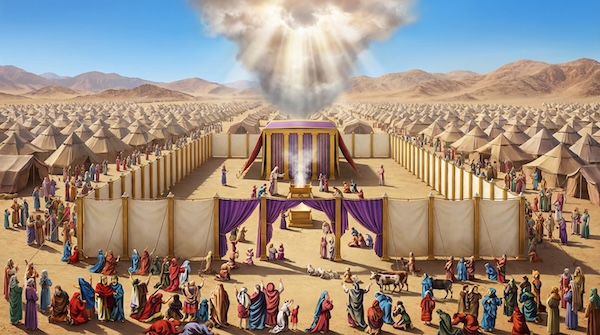
Rav Avigdor Miller zt’l made an incredible observation about the Mishkan. He points out how many pesukim across both Parshat Teruma and Tetzave, as well as portions of Ki Tisa, Vayakhel and Pekudei, describe the intricate details of the Mishkan and its accessories. So significant are the form and features of the Mishkan, that it takes over so many parshiot of the Torah. Yet, when we compare this to the narrative of Bereishit, the magnificent creation of the world, the Torah suffices with a mere few pesukim. What is the Torah telling us? That as wondrous as Hashem’s creation is, even more wondrous in the Torah’s eyes is the work of man…
The Gemara (Ketubot 5a) tells us “The deeds of the righteous are greater than the creation of Heaven and earth.” What are the deeds of the righteous? The construction of the Mishkan. In the words of Rabbi Miller zt’l “Hashem is demonstrating to us that the vast phenomenon of space, containing millions of worlds, is inferior to the little edifice which was erected in the Midbar…” In Hashem’s eyes, our small acts down here are more far-reaching than even the formation of the world!
There is a powerful Midrash (Midrash Rabba) which compares the Mishkan to the 7 days of creation because the Mishkan, our physical home for the Shechina, is equivalent to the entire universe.
Day 1: The sky is compared to a curtain in Tehillim and the Mishkan has a curtain of goat hair
Day 2: The division of the upper and lower waters is likened to the division between the kodesh and the kodesh hakedoshim
Day 3: The waters were gathered together which symbolizes the kiyor, the basin to wash in
Day 4: The creation of the luminaries is linked to the light of the Menorah
Day 5: The winged creatures (birds) correspond to the winged keruvim
Day 6: The creation of man is likened to the avoda of Aharon who performs the service of the Mishkan
Day 7: The completion of creation (Shabbat) is compared to the creation of the Mishkan
Our homes are often called a “mikdash me’at” a mini sanctuary for Hashem, reminding us of the pasuk in this week’s parsha “Build me a Mikdash that I may dwell in it.” Our homes are vessels for Hashem’s shechina. We may wonder how our little mundane acts of cleaning, cooking, shopping, washing and the myriad other tasks that fill our days hold any significance. But then we remember that the Torah dedicated so much space to the Mishkan, overriding even the creation of the world.
This Midrash speaks to me deeply as a Jewish woman because it tells me that the Mishkan – a physical structure as real as the home I am building – is a microcosm of the entire world, with all its potential for holiness. Everything physical we do is elevated above the most lofty plane itself- the Divine creation of the world.
Rebbetzin Mindy Bodner-Lankry notes that although the Mishkan was materially gorgeous, bursting with gold and the finest purple, crimson and even multicoloured thread, the beauty had to be a receptacle for kedusha in order to exist in the Mishkan.
The Aron was overlaid with gold, inside and out, yet the Torah cautions us to never leave it without the luchot habrit inside. The Menorah was a true work of art with elaborate branches and flowers and goblets, yet its wicks always had to be lit. The Shulchan was an impressive structure, but it had to hold the lechem hapanim at all times. Each physical item was laden with spiritual depth.
Our homes are often called a “mikdash me’at” a mini sanctuary for Hashem, reminding us of the pasuk in this week’s parsha “Build me a Mikdash that I may dwell in it.” Our homes are vessels for Hashem’s shechina. We may wonder how our little mundane acts of cleaning, cooking, shopping, washing and the myriad other tasks that fill our days hold any significance. But then we remember that the Torah dedicated so much space to the Mishkan, overriding even the creation of the world. That the Mishkan holds the entire universe, each of the seven days. And that each component of the Mishkan glows with a special beauty more splendid than the sum of its parts, the glorious materials donated to it – when they are used for a mitzva.
The Midrash Rabba tells us that the world was not really worthy of having gold exist in it until the creation of the Mishkan. It is not that we used the dazzling gold to elevate the Mishkan but that gold was only ever created to beautify the Mishkan. Whatever is beautiful in our homes wasn’t just placed there to give us an aesthetically pleasing home. We were given those beautiful tools in the first place to make our home Hashem’s.
In the words of Shlomo Hamelech who constructed the stunning Beit Hamikdash “tocho ratzuf ahava” “its inside lined with love.” Our Shulchan should not exist without its lechem hapanim. A new tablecloth? Save it for when the guests come. Our Menorah should not exist without its light. Gorgeous silver candlesticks? To welcome Shabbat. Our Aron should never be without luchot. All those house chores and errands? Like the sweeping of the Kohanim in the Mikdash.
“The deeds of the righteous are greater than the creation of Heaven and earth.” As women, we are privileged to fulfil this in our Mishkan, every single day.
Related articles




More articles by Tamara Klein
 Bamidbar: A True Household Leader
- Behar: A Godly Vision
- Emor: The Torah Definition of Chinuch
- Contrasting Women and the Sefira of Tiferet
- The Omer: A Long Chol Hamoed
- Acharei Mot-Kedoshim: Giving and Receiving Rebuke with Grace
- Tazria-Metzora: Women Are Inherently Connected to Purity
- Shemini: Jewish Women, The Mashgichot of their Households
- A Feminine Perspective on Matza
- Shemini: Jewish Women, The Mashgichot of their Households










One response to “Teruma: The Impact of Small Actions”
Absolutely beautiful and uplifting article , Tamara.
I find your writing so inspirational!
Good Shabbos